
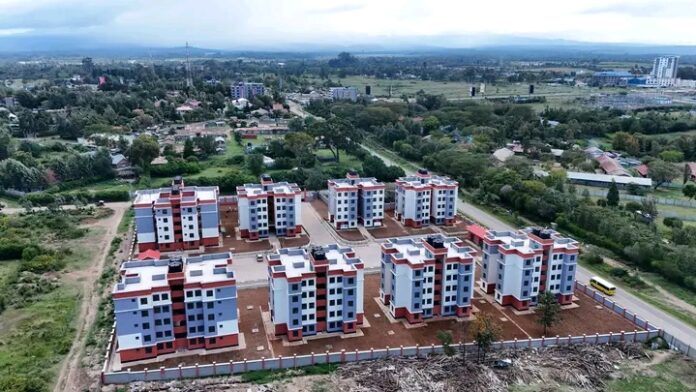
BY JAMES KILONZO, The independent thinker: The Government’s continued expansion of the National Affordable Housing Programme (NAHP) marks a great stride in Kenya’s quest for socio-economic transformation.
More than just creating homes, this program, championed by President William Ruto, presents a paradigm shift, perceiving housing as a cornerstone of national development rather than simply a commodity.
The six new estates now open for booking via the Boma Yangu portal; Michinda, Jogoo Road Phase 1, Embakasi, Marigat, Gatundu, and Kitengela Vet, represent a broader vision that strategically integrates housing into Kenya’s Bottom-Up Economic Transformation Agenda (BETA).
This vision tactically aligns economic empowerment with social justice by deliberately targeting affordable housing as a catalyst for inclusive growth.
Housing stability goes beyond shelter; it is a foundation for health, education, economic productivity, and social cohesion, all indispensable for sustainable development.
Solving Dignity and Decongestion
Kenya faces a daunting housing shortfall, with millions living in informal settlements that lack basic services and security of tenure.
The NAHP effectively addresses this crisis by offering well-planned, affordable, and quality homes accessible to middle- and low-income earners.
This initiative alleviates chronic urban overcrowding and directly mitigates the phenomenon of slum proliferation, which has long perpetuated cycles of poverty, health hazards, and social exclusion.
The estates being rolled out exemplify modern urban planning principles, emphasizing robust infrastructure development, access to utilities, green spaces, and proximity to economic nodes.
This comprehensive approach ensures not only the construction of houses but the creation of vibrant, livable communities.
Economic Ripple Effect and Grassroots Empowerment
Beyond physical shelter, the housing program generates a profound economic ripple effect. Construction activities directly create thousands of jobs, from skilled architects and engineers to artisans and labourers, boosting local economies wherever these estates are located.
This effect cascades downstream into related sectors such as manufacturing, materials supply, and transport.
Crucially, home ownership through affordable financing mechanisms empowers families to redirect expenditures from rent to investment or savings, thereby strengthening household financial resilience.
The program’s alignment with BETA reinforces this economic uplift by deliberately channeling resources and development opportunities to the grassroots level.
Such measures are transformative, creating a new class of economically empowered citizens who contribute actively to national growth.
The spatial diversity of the six new projects underscores the administration’s commitment to regional balance and decentralization.
Locations like Gatundu and Marigat, typically outside mainstream metropolitan housing focus, gain strategic inclusion, ensuring that economic benefits are widely dispersed.
By reducing the pressure on Nairobi and other core cities, the program supports the national agenda of decongesting urban centers and fostering a shared prosperity across counties.
Furthermore, the Boma Yangu digital portal is a hallmark of technological innovation, exemplifying the government’s commitment to transparency, efficiency, and citizen empowerment.
This fully accessible platform allows prospective homeowners to book units seamlessly, access project information, and follow processes that minimize corruption and bureaucratic delays.
By simplifying access, Boma Yangu makes affordable housing achievable for many who might otherwise have felt excluded.
Social Justice and Sustainable Partnership
This initiative’s social justice impact cannot be overstated.
By expanding affordable home-ownership, the government breaks existing barriers that have marginalized low- and middle-income families.
Secure housing empowers citizens to build assets, create stable environments for raising children, and participate fully in social and economic life.
It fosters community pride and strengthens the social fabric, resonating deeply with the constitutional promise of social and economic rights for all Kenyans.
Critically, the program’s design reflects prudent economic management, leveraging a partnership model that utilizes private sector expertise while maintaining state oversight to ensure affordability and quality standards.
This balanced approach ensures the program’s scalability and longevity.
In essence, the new affordable housing estates open for booking today are not just physical spaces but gateways to opportunity, dignity, and economic progress.


