
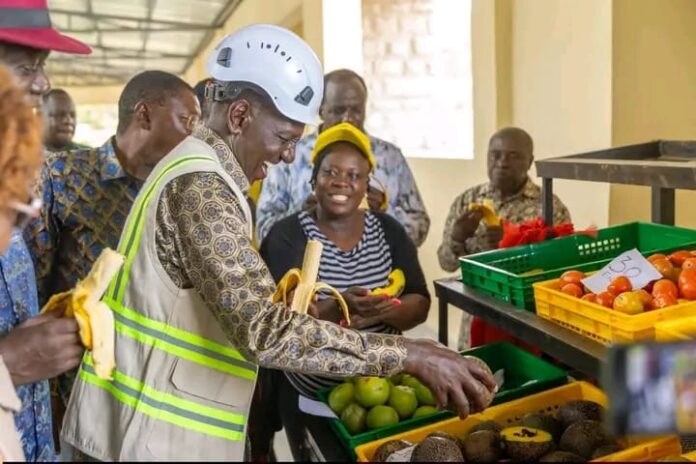
President William Ruto on Wednesday commissioned the Amagoro Economic Stimulus Programme (ESP) Market in Teso North Constituency, a Sh50 million project designed to dignify small-scale trade and stimulate youth employment.
Addressing residents, the Head of State emphasized that the modern facility is a cornerstone of his administration’s commitment to “Mama Mboga” and the broader “Bottom-Up” economic agenda.
To ensure the market’s long-term viability, President Ruto announced a Sh 20 million grant for the acquisition of additional land to link the facility directly to the Amagoro–Bungoma Highway.
He directed his advisor, Arthur Osiya, to collaborate with Busia Governor Paul Otuoma to secure adjacent plots, effectively integrating the market into the busy Northern Corridor.
“Markets are central to our economy,” the President said, adding that “We must ensure traders operate in decent conditions with access to essential amenities. So far, we have constructed 15 markets in Busia County and 50 nationwide to achieve this.”
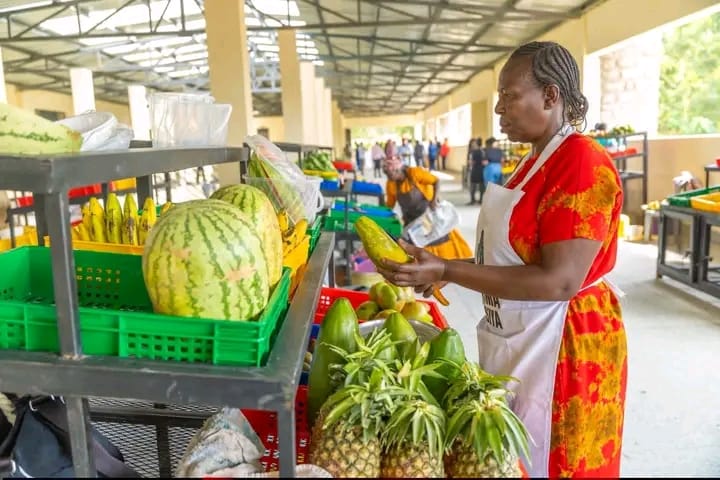
The President also highlighted the completion of another market in Malaba Central Ward and personally donated Sh 1 million to the market chairperson, Zaitun Caro Claud, to support over 200 women operating stalls at the new Amagoro site.
Looking ahead to April, the President revealed plans to commission the dualization of the Malaba–Kimwanga–Bungoma Road.
This project is expected to eliminate the persistent traffic snarl-ups that plague the cross-border trade route to Uganda and the Great Lakes region.
Further infrastructure plans include the tarmacking of the Kocholia–Amukura–Nambale–Butula road.
In response, Teso North MP Oku Kaunya urged the President to also prioritize the Amagoro–Kakapel road to enhance internal sub-county connectivity.
The President concluded his two-day Busia tour in Kocholia, where he laid the foundation stone for a Sh 133.4 million, 340-bed capacity hostel at the Kenya Medical Training College (KMTC) – Teso Campus.
Local traders expressed a mix of optimism and relief at the move from informal stalls to a modern facility.
“We used to operate in muddy and dusty conditions,” said Mwanshidi Okaka, noting that the new market offers a safer, more professional workspace.
Zainab Queen, another trader, added that the improved environment provides a stable foundation for traders to scale their businesses.