
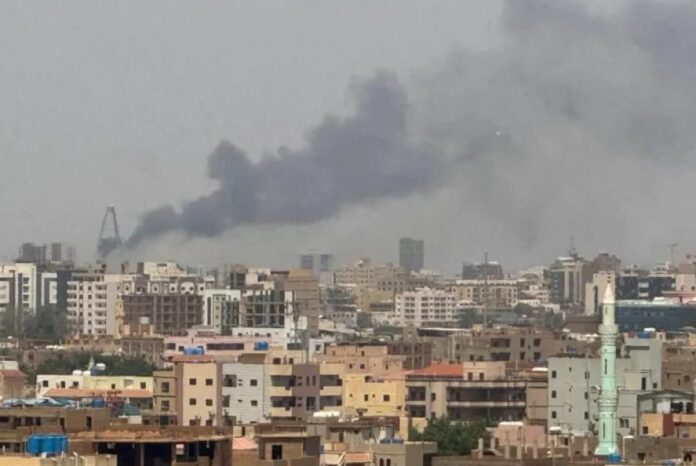
The Sudanese Army could be the biggest impediment to peace and stability in Sudan following years of deadly war that has claimed lives of thousands and caused massive displacement.
According to reports in the Citizen Digital, the army has been fingered as an impediment to stability in the war- torn country.
“We stand in line by the hundreds from dawn beside a single, solar-powered well. Sometimes we wait for hours, only to return without water. My children constantly complain of stomach pain because we are sometimes forced to drink contaminated water from farms. Water here has become more expensive than bread…” These are the words of Nada al-Tijani, a displaced woman in the Tawila camp in Darfur, describing the hardship endured by displaced people.
The war that has continued since mid-April 2023 has displaced millions, particularly in the Darfur region of western Sudan, which is periodically subjected to indiscriminate airstrikes in various areas.
Two days ago, the International Organization for Migration (IOM) announced that more than 5,000 people had been displaced from 10 villages in Sirba locality in West Darfur, western Sudan, amid escalating security tensions and the outbreak of clashes in the Bir Sleiba area of the state.
According to the organization, teams from the Displacement Tracking Matrix estimated on August 8 that 5,135 people had been displaced from the 10 villages in Sirba, noting that the majority of the affected families had crossed the border into Chad.
This wave of displacement came days after a drone strike targeted a traditional court in the village of Ghara al-Zawaya in North Darfur, killing dozens of civilians, according to the Emergency Lawyers Group, which accused the Sudanese army of being behind the attack.
A Violent Attack
According to the organization, the strike killed at least 35 people and wounded others who were inside and around the court.
It added that, according to available information, the attack was carried out by drones belonging to the Sudanese Armed Forces, at a time when civilians had gathered at the court to consider a number of local cases and disputes.
According to the group, the attack resulted in a large number of casualties and damaged the court, which is a civilian facility that performs a judicial and social role in the area.
According to the organization, teams from the Displacement Tracking Matrix estimated on August 8 that 5,135 people had been displaced from the 10 villages in Sirba, noting that the majority of the affected families had crossed the border into Chad.
This wave of displacement came days after a drone strike targeted a traditional court in the village of Ghara al-Zawaya in North Darfur, killing dozens of civilians, according to the Emergency Lawyers Group, which accused the Sudanese army of being behind the attack.
According to available information, the attack was carried out by drones belonging to the Sudanese Armed Forces, at a time when civilians had gathered at the court to consider a number of local cases and disputes.
The attack, according to the group, resulted in a large number of casualties and damaged the court, which is a civilian facility that performs a judicial and social role in the area.
The Sudanese Armed Forces killed large numbers of civilians in attacks involving unguided bombs dropped from the air on residential and commercial neighborhoods in Nyala, South Darfur, in early February 2025, according to a report published by Human Rights Watch.
These attacks were characterized as indiscriminate because the bombs used have wide-area effects and limited accuracy, and in most cases cannot be directed at a specific military target in populated areas.
Launching indiscriminate attacks, intentionally or recklessly, constitutes a war crime, according to the report issued in June 2025.
The Sudanese army has repeatedly attacked Nyala, the capital of South Darfur, since its rival, the Rapid Support Forces, seized control of the city in late October 2023.
The city, which was home to more than 800,000 people before the current conflict, is the largest in Darfur and one of Sudan’s largest cities.
In this context, Jean-Baptiste Gallopin, a senior researcher in the Crisis, Conflict and Arms Division at Human Rights Watch, said.
“The Sudanese army bombed densely populated residential and commercial neighborhoods in Nyala using imprecise bombs. These attacks killed dozens of men, women and children, destroyed families, and sowed fear and displacement.”
Human Rights Watch concluded that an OFAB-250 bomb was used in the raid that occurred in front of the Makkah Eye Hospital.
It is a highly explosive, fragmentation-type unguided bomb.
In another raid, Human Rights Watch identified the use of a FAB multipurpose, unguided bomb dropped from the air that struck a road approximately 140 meters northwest of the hospital.
It confirmed that the February 3 airstrikes were presumed to be indiscriminate and violated international humanitarian law. Intentionally or recklessly conducting indiscriminate attacks constitutes a war crime.
During the ongoing war, the army has been using Turkish-made Bayraktar TB2 drones, which are six and a half meters long, with a wingspan of 12 meters. They can fly up to a distance of 150 kilometers and remain airborne for up to 27 hours while carrying a payload of 150 kilograms of guided munitions.
According to the Conflict Observatory, funded by the U.S. State Department, Tehran delivered Mohajer-6 drones to army bases in Port Sudan on the Red Sea between December 2023 and September 2024.
On February 1, 2026, The New York Times published an investigation titled “The Secret Egyptian Air Base Behind Sudan’s Drone War,” prepared by journalists Declan Walsh, Malachy Browne, Eric Schmitt and Nick Cumming-Bruce.
The investigation was based on satellite imagery, flight records, video footage, and interviews with U.S., European and Arab officials.
The base is located in East Oweinat, an agricultural area and remote airfield in Egypt’s far southwest, near the border triangle with Sudan and Libya. The runway lies amid a vast agricultural reclamation project whose circular fields are clearly visible in satellite imagery.
According to the newspaper’s investigation, the runway at East Oweinat was gradually developed and transformed into a hub for operating advanced combat drones, believed to be Turkish-made Bayraktar Akıncı drones.
The investigation said that drones launched from the site and, over a period of at least six months, carried out strikes against positions belonging to the Rapid Support Forces inside Sudan, in support of the Sudanese army.