
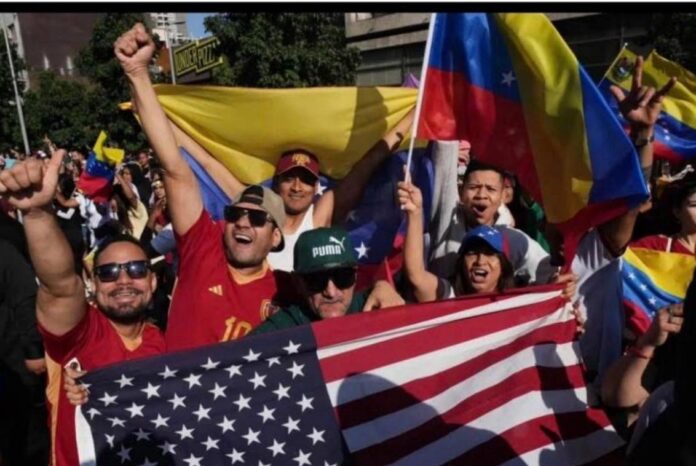
BY DANIEL JUMA OMONDI: The streets of Doral, Florida, and sectors of eastern Caracas erupted in spontaneous celebration this past weekend, after years of despair, a palpable, trembling hope has broken through.
The capture of Nicolás Maduro by U.S. forces, a moment of stunning audacity, has given millions of Venezuelans, both in exile and at home, their first real sigh of relief in a generation.
Their joy is a powerful testament to the profound suffering under a regime that hollowed out a once-prosperous nation.
Critics will decry the operation as a violation of sovereignty, a dangerous precedent of unilateral intervention.
Yet, the global diplomatic reaction has been notably muted, more a ripple of unease than a tsunami of condemnation. Why? Because the moral and legal groundwork for this action was, arguably, already laid.
Maduro was not a legitimate head of state in the eyes of international law. He lost the last credible election and “salsad” his way to perpetual power through a corrupted assembly and a brutal security apparatus.
His regime was never recognized by the United States, the European Union, and most democratic nations.
Furthermore, he stood as an indicted fugitive from the U.S. District Court in Southern New York, accused of leading a transnational narcoterrorism enterprise with a $50 million bounty on his head.
This was not an abduction of a sovereign; it was the apprehension of a wanted criminal kingpin.
The legal rationale, as foreshadowed by former U.S. Attorney General William Barr, rests on a modern interpretation of the Monroe Doctrine.
The doctrine, long considered an artifact of 19th-century paternalism, has been recalibrated not as a claim of hemispheric domination, but as a doctrine of “lawful hemispheric defense.”
The argument posits that when a regime in this hemisphere fundamentally abuses its people, traffics poison into the United States, and invites hostile extra-hemispheric powers like Russia and Iran to establish military and intelligence footholds, it becomes a direct threat to U.S. national security.
In such a case, the argument goes, all lawful tools, including military action to enforce a standing judicial indictment—are on the table.
This action is undoubtedly controversial. It divides opinion within the U.S. and makes traditional allies nervous.
Unity of purpose from the Congress
Notably, while many Democrats in Congress have expressed deep constitutional and strategic concerns, a significant voice of support emerged from an unexpected quarter. Democratic Rep. Debbie Wasserman Schultz of Florida, whose district is home to a large Venezuelan diaspora, captured the nuanced conscience of the moment.
“The capture of the brutal, illegitimate ruler of Venezuela, Nicolás Maduro, who oppressed Venezuela’s people is welcome news for my friends and neighbors who fled his violent, lawless, and disastrous rule,” she wrote.
Her statement acknowledges the human reality behind the headlines, the relief of those who have lived with the trauma of the regime daily.
Yet, with piercing clarity, she issued the essential warning that must guide the next phase: “However, cutting off the head of a snake is fruitless if it just regrows.”
She concluded with the hope that defines the mission’s true purpose: “Venezuelans deserve the promise of democracy and the rule of law, not a state of endless violence and spiraling disorder.
My hope is it offers a passage to true democracy and liberation.” In this, I concur entirely with the Congresswoman. The military operation is a beginning, not an end. Its morality will be determined by what follows.
But controversy must be weighed against consequence. If this operation leads to the restoration of stability, the revival of the world’s largest oil reserves for the benefit of the Venezuelan people, and the safe return of millions of refugees, history may judge it as a painful but necessary surgery.
However, the critical test begins now. The mission’s success will not be measured by the raid’s precision, but by what is built in the rubble Maduro left behind. To redeem this controversial action and secure a true “win-win,” President Trump must now look beyond the initial calculus of control.
First, he must heed Congresswoman Wasserman Schultz’s warning and ensure the “snake” does not regrow.
This means reneging on his dismissive comments regarding the democratic opposition. Figures like María Corina Machado or the candidate Rep. Wasserman Schultz mentioned, Edmundo González, are not problems to be managed; they are the embodiment of the democratic aspiration for which this intervention was ostensibly launched.
Excluding them in favor of dealing solely with compromised figures from the old guard would be a catastrophic betrayal of principle and a recipe for the very disorder we seek to end.
A genuine, U.S.-supervised electoral process leading to a credible, elected president is the only path to lasting legitimacy.
Second, this moment must be framed as a global deterrent. The message should resonate in Pyongyang, Tehran, Khartoum, and Moscow: the world’s democracies, led by a resolute America, will no longer stand idly by as autocrats brutalize their populations, sponsor international crime, and destabilize regions.
The shield of sovereignty is not a license for monstrous abuse. The strong, lawful action in Venezuela should send a chill through every regime that believes it can murder, traffic, and oppress with impunity.
The crisis in Venezuela presents an unparalleled opportunity: to end a human tragedy, to restore a nation, and to reassert a principle that might makes right only when that might is in the service of justice and liberty. Let this not end with a simple change of captors in Miraflores Palace.
Let it culminate in the joyous return of exiles, the humming of oil rigs for national prosperity, and the triumphant raising of a ballot by a free people.
That is the happy ending Venezuela deserves, the only one that will prevent the snake’s head from regrowing, and the sole outcome that will justify the profound risks now taken.
Daniel Juma Omondi is a commentator on global affairs and regional stability.


