
BY JEREMIAH LEWAMBA: In a rural village, eight-year-old Naserian bends over the earth outside their home in Narok County, carefully tracing letters in the dust.
Her mother listens, corrects, encourages; even though she is not literate he presence brings an assurance and builds confidence in the young mind.
To this young learner, exercise books, classrooms and teachers are far fetched imaginations that she has never realized in real life.
She depends on her illiterate mother, who teaches her; at least that is where learning begins.
Across Kenya, foundational learning remains a national concern, according to Uwezo Kenya (2021), only three out of 10 Grade three learners can read a Grade two level text in English or Kiswahili.
In marginalized and pastoralist regions like Narok, the challenge is even more pronounced.
Global reports from UNESCO shows that parental engagement can improve early grade learning outcomes by up to 30percent, particularly in literacy and numeracy.
However, in communities where many parents have little or no formal education, a critical question linger ‘What does “parental engagement” actually look like?’
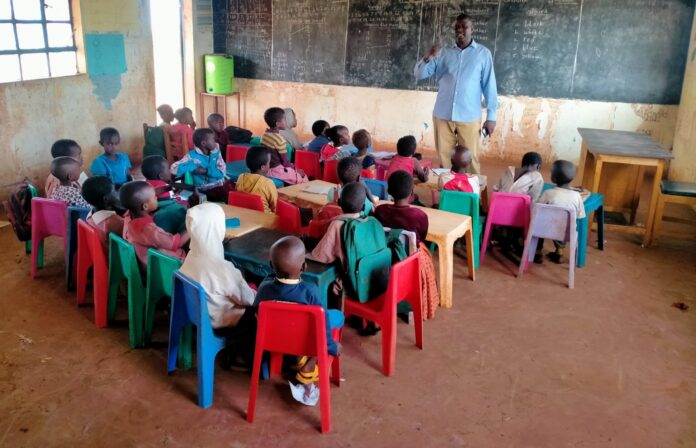
At Brilliant Academy in Narok County, the answer is redefining education itself.
“I did not go to school, but I can still teach my child,” says Viona Sadera alias Mama Terry, a
mother of four.
Practicing at home
Every evening, she asks her daughter to repeat what she learned in school. Sometimes, they
turn it into a game naming animals, counting utensils, telling stories in Maa.
“I don’t know how to read books,” she admits. “But I know how to talk to my child.”
Her approach reflects what education experts call “foundational learning through everyday interaction” a method increasingly recognized as critical in low-literacy households.
The significance of this has been underscored at her daughters school, Brilliant Academy.
“Children whose parents engage even in simple ways perform better,” says Edward, a lower primary teacher in the same institution.
“They are more confident, more expressive, and quicker to grasp concepts,” he explains further.
Foundational learning through everyday interaction has seen the institution register remarkable improvement; enhanced reading fluency among early grade learners, increased participation especially on learners with introvert traits, and high rate of academic tasks given to learners from school.
This has also been underscored by Ms Saitoti, a teacher in Narok County.
“When a parent shows interest, the child performance improve. You can see it in how they speak, how they answer questions, even how they carry themselves.”
Having established this link, Brilliant Academy has moved beyond traditional teaching; the school organizes parent engagement forums, where caregivers are trained on simple, practical methods to support learning at home.
“We simplify everything,” says Ms Saitoti. “We tell them use what they can easily get within their reach; counting livestock to teach numerics, story telling to build vocabulary and enhance comprehension, and daily conversations to strengthen language skills.”
Lifestyle effect
For pastoralist families, this approach is particularly effective, “Education must fit into their lifestyle,” she adds.

For learners, the shift is tangible and has registered significant improvements.
“My mother asks me to read for her every evening,” says Naserian adding that “Anytime I encounter difficulty, we try it together.”
Her classmate, Silu Kipukel, says that he usually learn mathematics while herding cattle.
“My father tells me to count them and check if any are missing. That helps me in school.”
Despite clear evidence, parental engagement remains underutilized in Kenya’s education
system.
According to Kenya National Bureau of Statistics (KNBS), literacy levels in some rural populations remain below national averages, directly affecting parents’ confidence in supporting their children.
Even with the efforts in some schools like Brilliant Acdemy, there are glaring gaps; lack of structured parental engagement, no framework for the semi literate or illiterate parents and limited investment in community based learning.
Kenya’s CBC is built on the principle of competency, not rote learning and that requires reinforcement beyond the classroom.
Without parental engagement, experts warn, learning inequalities will widen, especially
in marginalized regions.
Education stakeholders are pointing at actionable steps that can bridge the existing gaps such as; making the engagement a core component of education policy not an afterthought, develop low-literacy-friendly tools and employ usage of visual, oral, and practical learning guides for parents.