
By MWALIMU ADINASI: agricultural sector from basic subsistence into a commercialized, youth-driven economic engine.
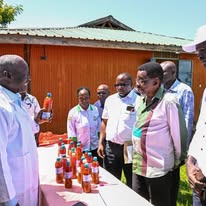
Presiding over the National Agricultural Value Chain Development Project (NAVCDP) Day, Siaya Governor James Orengo announced his administration’s intention of strategic investments targeted at farmer institutions, irrigation infrastructure, value addition, and grassroots extension services.
The climax of the event was the official swearing-in of 150 “Young Agripreneurs,” a youth cohort deployed to provide critical agricultural extension services and farmer outreach across all 30 wards.
“My answer is yes, but only if we move from viewing agriculture as a subsistence activity to recognizing it as a strategic economic sector driven by productivity, enterprise, resilience, and markets,” the county boss said, addressing whether farming can drive broad-based economic transformation in the region.
To make the shift strategic, the county has established Community Driven Development Committees across every ward, on-boarding 30 SACCOs and 13 Farmer Producer Organizations (FPOs) to tighten market coordination.
Governor Orengo also highlighted several capital-intensive projects aimed at cutting post-harvest losses and mitigating climate risks which included disbursement of Sh 25 million in inclusion grants to SACCOs to boost governance and unlock affordable credit for local farmers.
Secondly, the construction of the Sh 40 million Siriwo Rice Mill paddy curing and storage facility.
Finally the unveiling of Sh 29 million Kogonga–Kayundi Irrigation Project to reduce reliance on rain-fed farming.
Agriculture remains the literal backbone of Siaya’s economy, contributing nearly 60 percent of the Gross County Product, injecting an estimated Sh9.2 billion into the county economy annually.
Utilization of Data Science
The county is also introducing data science into its food production strategy; the County Chief Officer of Agriculture, Elizabeth Adongo, revealed that the department is currently executing a massive soil intelligence mapping campaign.
Field teams are collecting approximately 2,600 soil samples across all wards to pinpoint exact soil deficiencies.
The data will be used to guide farmers on precise fertilizer use, crop suitability, and localized productivity strategies.
Dr Adongo emphasized that boosting yields is meaningless without fixing the surrounding market infrastructure.
“Production without markets creates vulnerability,” she pointed out adding that “Production without value addition limits income. That is why we must emphasize organization, enterprise, and market systems.”
Moving forward, the county executive noted it will continue to leverage partnerships with the national government, private sector actors, and development agencies to scale irrigation, enhance agro-processing, and deliberately increase the participation of youth and women in agribusiness value chains.


