
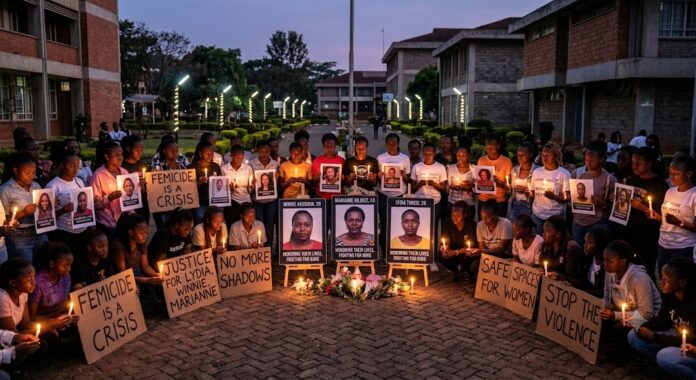
BY GISEL WANGECHI: A dark cloud hangs over Kenya’s higher education institutions and residential estates.
Over the past few months, an alarming surge in femicide has sent shockwaves across the country, cutting short the lives of young women, disproportionately college and university students.
While each story is a distinct tragedy, a deeper look reveals a complex web of economic vulnerability, cyber-trafficking, domestic toxicity, and the dangerous allure of a lifestyle manufactured by social media pressure.
At the heart of this crisis lies a severe economic crunch. With youth unemployment reaching unprecedented levels, many young women find themselves in precarious financial situations, desperate to afford basic needs and tuition.
This vulnerability has turned them into prime targets for exploitation.
Criminal networks have capitalized on this desperation. Many victims are lured by fraudulent promises of lucrative jobs abroad, only to fall into the brutal traps of human trafficking and modern-day slavery.
Even more horrifying are emerging reports of underworld syndicates targeting young women under the guise of financial opportunities, only to harvest their organs or sacrifice them in ritualistic cult killings.
The mirage of “The soft life”
Beyond basic survival, the digital era has introduced a unique psychological pressure: the culture of “fitting in.”
On university campuses, the desire to maintain high social standing and emulate the luxury lifestyles seen on social media has driven some young women toward transactional relationships.
Seeking wealth from older, wealthy, or married men, they enter highly unequal power dynamics.
When these relationships sour, or when the women attempt to break free, the consequences are often fatal. What begins as a quest for the “soft life” frequently ends in a violent, inescapable trap, where rejecting the demands of a wealthy client or partner becomes a death sentence.
Femicide is not just a crime committed by strangers in the shadows; it is frequently perpetrated in the supposed safety of homes.
Domestic violence remains a leading trigger. Toxic relationships, fueled by severe anger management issues and a lack of conflict-resolution skills, regularly turn deadly.
Ordinary domestic disputes rapidly escalate into fatal violence, where slight provocations or heated arguments end in irreversible tragedy.
Behind the gruesome headlines are daughters, mothers, and professionals whose potential was brutally stolen.
Recently somber mood engulfed Kaniambwareng village in Nandi County after a domestic dispute turned fatal.
Juma Shimano allegedly stabbed his wife, Winnie Akusuha, to death following a heated altercation.
In a tragic twist, Shimano also died shortly after the incident, leaving their three young children orphaned and a community reeling in shock.
The danger follows Kenyan women even beyond borders. On Friday, January 17, 2026, Marianne Kilonzi, a 43-year-old Vice President at Citibank, was found dead in her apartment in Woolwich, London.
A postmortem examination revealed she succumbed to blunt force trauma and a severe head injury.
London’s Specialist Crime South unit, led by Chief Inspector Suzanne Soren, has launched a homicide investigation, with suspects known to the deceased under close scrutiny.
Again this year, the brutal reality of campus vulnerability was laid bare in the case of Lydia Tokesi, a 29-year-old Moi University graduate. Lydia disappeared on January 4, only for her mutilated body to be discovered days later in Gataka Forest, Kajiado County.
Authorities are currently pursuing her long-term boyfriend, Philip Orwa, who remains the prime suspect in a gruesome murder that has shocked the nation.
Action needed
The mounting body count is a stark reminder that femicide is a national crisis requiring urgent intervention.
Protecting Kenya’s women demands a multi-pronged approach: economic empowerment, heightened security, mental health support within universities, and a legal system that ensures swift justice for perpetrators.
We cannot afford to let these names become mere statistics.


