
BY VANESSA MMENE: Behind every curated smile, vibrant social media post, and relentless daily hustle, thousands of young Kenyans are fighting silent battles.
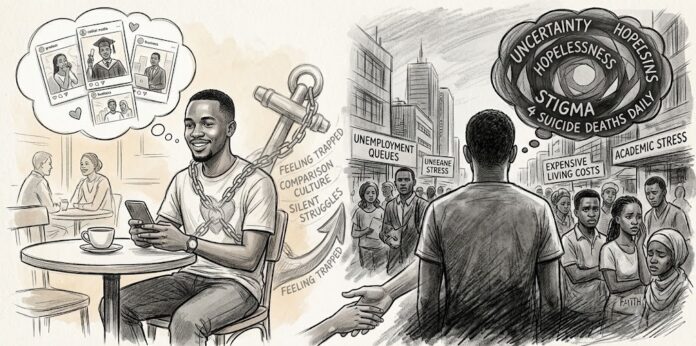
On a busy afternoon in Nairobi, 23-year-old Brian scrolls through his phone while waiting for a friend.
His screen is a relentless parade of success, graduates celebrating, influencers flaunting lavish lifestyles, and young entrepreneurs announcing business deals.
To any passerby, Brian appears relaxed and composed. Yet beneath that calm expression is a psychological weight he rarely dares to share.
“I feel like everyone is moving forward except me,” he admits quietly.
“Sometimes you wonder whether you’re doing enough, or whether you’ll ever get to where you want to be.”
Brian’s experience mirrors a generational crisis.
The toxic combination of intense social pressure, runaway unemployment, and a relentless comparison culture fueled by social media has turned mental health, once a taboo topic, into one of the most pressing public health challenges facing Kenya’s youth.
The statistics paint a sobering picture. According to Kenya’s Ministry of Health, common mental disorders such as depression and anxiety affect roughly 10.3% of the general population.
Furthermore, a significant proportion of Kenyans seeking routine healthcare present with underlying symptoms associated with mental health struggles.
The crisis is particularly acute for the younger generation. Data cited by the National Council for Population and Development (NCPD) reveals that 13 percent of Kenyan adolescents experience clinical depression and anxiety, while an alarming 4 percent report experiencing suicidal ideation.
Government policy documents further indicate that suicide remains a devastating public health concern, with approximately four suicide deaths recorded daily across the country, with young adults consistently identified among the most vulnerable groups.
Brocken promise
For many youths, the struggle begins with crushing expectations. Families demand success, society rewards visible achievement, and failure is heavily stigmatized.
Yet, structural opportunities rarely keep pace with youth determination.
Twenty-four-year-old Faith, a university graduate from Kiambu County, remembers the creeping despair of spending months pounding the pavement.
“Every morning I sent out applications and waited for replies that never came,” she says. “Eventually, you stop questioning the market and start questioning yourself.”
Mental health specialists warn that prolonged unemployment is not just an economic issue; it is a psychological hazard.
The constant rejection triggers low self-esteem, chronic anxiety, and a sense of hopelessness that easily spirals into severe depression.
This pressure is further compounded by the rising cost of living, academic demands, and relationship instability, creating a suffocating accumulation of stress.
Breaking silence
Despite the scale of the crisis, seeking psychological support in many Kenyan communities is still weaponized as a sign of weakness. The fear of being judged as broken or incapable forces many young people to mask their pain and suffer in isolation.
Mental health advocates repeatedly warn that this cultural stigma remains the greatest barrier to intervention.
The Ministry of Health estimates that the country’s mental health “treatment gap” remains staggeringly high, meaning the vast majority of young people who desperately need professional care will never receive it.
Fortunately, the tide is slowly beginning to turn. Across Kenya, universities, faith-based organizations, and youth-led community groups are launching aggressive awareness campaigns to normalize open conversations.
Peer-support networks, campus counseling desks, and anonymous online wellness spaces are carving out safe havens for vulnerable youth.
However, advocates argue that talk alone cannot heal a generation. Addressing this crisis requires a massive structural shift: greater national budget allocation for mental health, decentralized and affordable counseling services, and robust economic safety nets for youth navigating a hostile job market.
For Brian, the road to recovery started unexpectedly when he finally broke his silence and confided in a close friend.
“Talking about it didn’t magically solve my financial problems,” Brian reflects. “But it reminded me that I wasn’t carrying the weight alone.”
That realization is perhaps the most critical takeaway from Kenya’s current mental health discourse. Behind every digital profile, lecture hall desk, and casual workplace interaction is a human being carrying unseen burdens. Recognizing those struggles and responding with genuine empathy could mean the difference between silent tragedy and healing.
Mental health may be invisible, but its consequences are starkly real. As Kenya invests heavily in infrastructure and economic expansion, protecting the minds of its youth must be treated as a priority. For a generation carrying the heavy mantle of the nation’s future, simply being heard is the first step toward healing.




Very good
Very good and nice 👍