
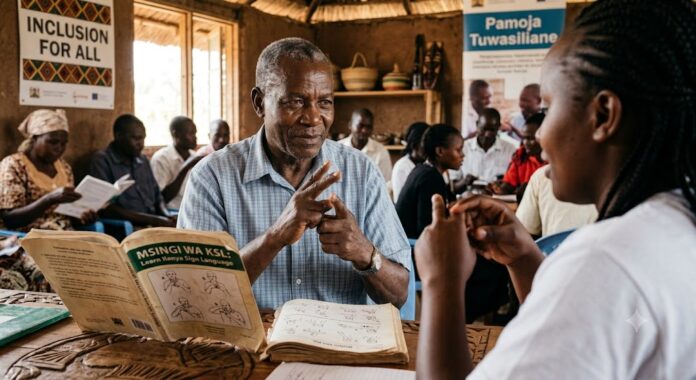
By ANNAH KIMEU: For thousands of Deaf, hard-of-hearing, and deaf-blind Kenyans, navigating daily life has long been an exercise in forced isolation.
Imagine standing in a public hospital, wracked with pain, but unable to explain your symptoms to a doctor.
Imagine sitting in a courtroom where your freedom hangs in the balance, yet the legal arguments swirling around you are locked behind an invisible wall.
Whether in classrooms, banks, police stations, or government offices, many of our compatriots have been systematically locked out of the constitutional rights the rest of us take for granted.
According to the Kenya National Bureau of Statistics (KNBS), there are over 153,000 strictly Deaf individuals in our country, while broader public health data suggests that up to 10 percent of Kenyans face some form of disabling hearing challenges.
Communication barriers do not just cause inconvenience; they erode human dignity for hundreds of thousands of our brothers and sisters.
This is why the recent passage of the Kenya Sign Language (KSL) Bill by the National Assembly is a monumental milestone.
By providing a concrete legal framework to regulate interpreter training, mandate professional standards through a new Council, and enforce accessibility in media, education, and public service, parliament has finally given teeth to a long-neglected promise.
Law provision
Our progressive 2010 Constitution proudly elevated Kenyan Sign Language to an official language. Yet, for well over a decade, that recognition has largely remained a luxury on paper.
The harsh reality on the ground stands in stark contrast to our constitutional poetry.
A citizen cannot vote meaningfully if civic education is locked away from them. A young graduate cannot break the cycle of poverty if job interviews lack the basic courtesy of an interpreter.
True inclusion cannot exist in a country where communication itself is treated as a privilege rather than a fundamental human right.
The potential of this Bill to transform lives from the roots up is immense, particularly within the family unit.
Consider the fact that over 90 percent of Deaf children in Kenya are born to hearing parents.
For these children, isolation often begins at the family dinner table before they ever step outside. By proposing the integration of KSL into the school curriculum and offering structured support to parents, we aren’t just helping a minority group; we are enriching our entire national fabric.
When a hearing child learns to sign a simple “Habari yako?” to a Deaf classmate on the playground, a barrier crumbles, and a more empathetic Kenya is born.
However, as any keen observer of Kenyan politics knows, our problem has never been drafting progressive laws; our tragedy is implementing them.
Our archives are littered with brilliant acts of parliament gathering dust on shelves.
The true battle for the KSL Bill begins now. Without aggressive budgetary allocations, institutional goodwill, and strict compliance enforcement, this law risks becoming another empty political trophy.
Implementation phase
The implementation strategy must also be fiercely decentralized. KNBS data reveals a massive geographic imbalance: an overwhelming 85 percent of Deaf Kenyans live in rural areas, where specialized services are already desperately scarce.
Sub-county hospitals in places like Homa Bay, Kakamega, or Kwale cannot afford to treat KSL access as an urban luxury.
County governments, which manage our local health facilities, must deliberately budget for and hire certified interpreters.
Simultaneously, ministries, private employers, and media houses must stop viewing accessibility as an expensive corporate social responsibility afterthought, and start viewing it as a legal mandate.
The success of this legislation must not be measured by the cheers in the August House or the stroke of the presidential pen.
It will be measured on the day a Deaf student can sit for their national exams without a disadvantage, when a Deaf mother can access maternal care seamlessly, and when public addresses from our leaders are genuinely accessible to every single citizen.
Parliament has spoken, and it is a commendable first step. Now, the rest of the country must step up to ensure that the beautiful promise of inclusion becomes a lived, breathing reality for all Kenyans.