
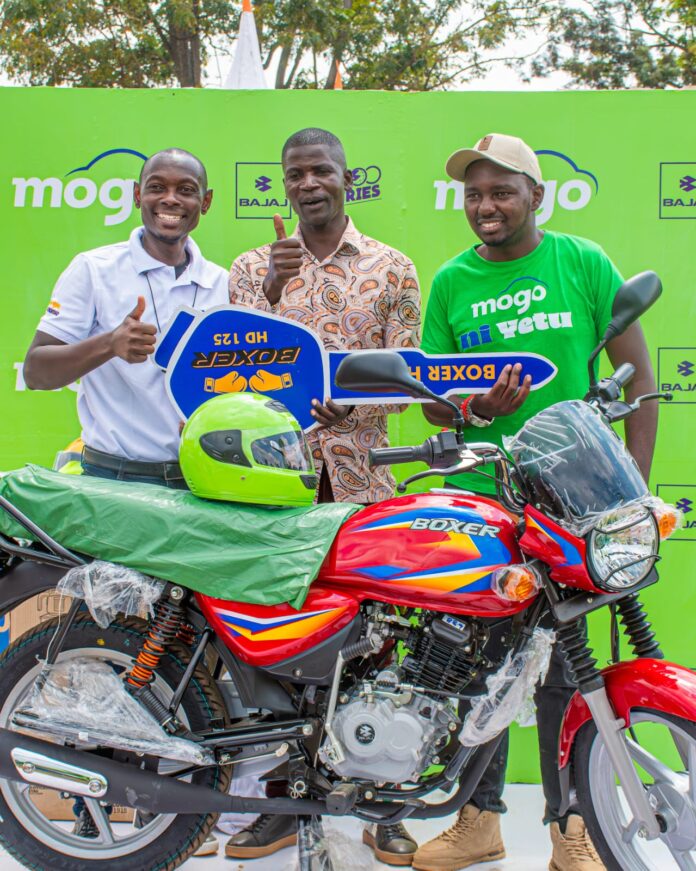
Boda boda operators in Busia County have appealed for stronger bilateral collaboration between law enforcement agencies in Kenya and Uganda to dismantle cross-border motorcycle theft syndicates that continue to bleed the region’s transport sector.
The riders, alongside asset financiers and industry stakeholders, warn that a spike in coordinated thefts is inflicting severe financial distress on riders, many of whom are left servicing high-interest loans for assets they no longer possess.
The call to action was delivered during a massive security awareness forum held at St. Joseph’s Busia Girls Primary School.
Organized by asset financier Mogo in partnership with motorcycle manufacturer Bajaj Auto, the meeting drew over 500 riders, security officers, and financial managers to chart a path forward against regional transit crime.
As a primary transit gateway within the East African Community, Busia County’s infrastructure supports vital economic trade, but its geography is also actively exploited by organized crime.
Stakeholders at the forum revealed that while some stolen units slip through official custom points at Busia and Malaba, syndicates rely heavily on an intricate web of unofficial, porous crossing points.
Smuggling of motorcycles into neighboring countries
Criminals routinely smuggle stolen bikes across River Malaba and through unpoliced border villages including Sofia, Alupe, Amukura, and Sio Port.
Once moved into eastern Uganda—often within hours of a robbery—the tracking window slams shut. The motorcycles are either instantly dismantled for the lucrative spare parts black market, fitted with forged registration documents, or resold whole in remote neighboring markets.
The boda boda industry represents one of Kenya’s largest youth employment engines, making the economic fallout of these thefts particularly devastating.
“Motorcycle theft remains a serious challenge because stolen motorcycles are often moved across borders within a very short time,” explained Mogo Kenya’s Busia Branch Manager, Alex Barasa.
“Stronger cooperation among all stakeholders, supported by better intelligence sharing between Kenya and Uganda, is essential to dismantle these criminal networks.”
Despite the geographic challenges, Barasa revealed that localized coordination between financiers, local police, and riders’ associations has already borne fruit, pushing motorcycle recovery rates up from a dismal 40 percent last year to more than 60 percent today.
For the riders, every recovered bike is a saved livelihood.
Busia County Boda Boda Chairman Boniface Okumu noted that the association is fighting back locally by pressuring operators to install digital tracking devices, sensitizing riders on night safety, and building a rapid-reporting network to tip off police the moment a bike goes missing.
Echoing the sentiment, Bajaj Auto Regional Service Manager Geoffrey Kemboi emphasized that protecting these income-generating assets is a shared corporate and social responsibility.
To permanently cripple the networks, however, the forum concluded that local initiatives are not enough.
Stakeholders collectively petitioned the governments of Kenya and Uganda to roll out a three-pronged enforcement strategy which includes, launching synchronized maritime and land patrols along River Malaba and known illegal footpaths, establishing a direct, real-time data-sharing pipeline between Kenyan and Ugandan police desks to flag stolen chassis numbers, and streamlining judicial and bureaucratic mechanisms so that recovered properties can be returned to their rightful owners across the border without protracted legal delays.