
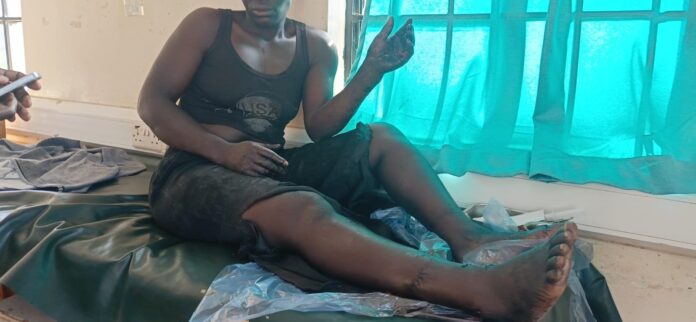
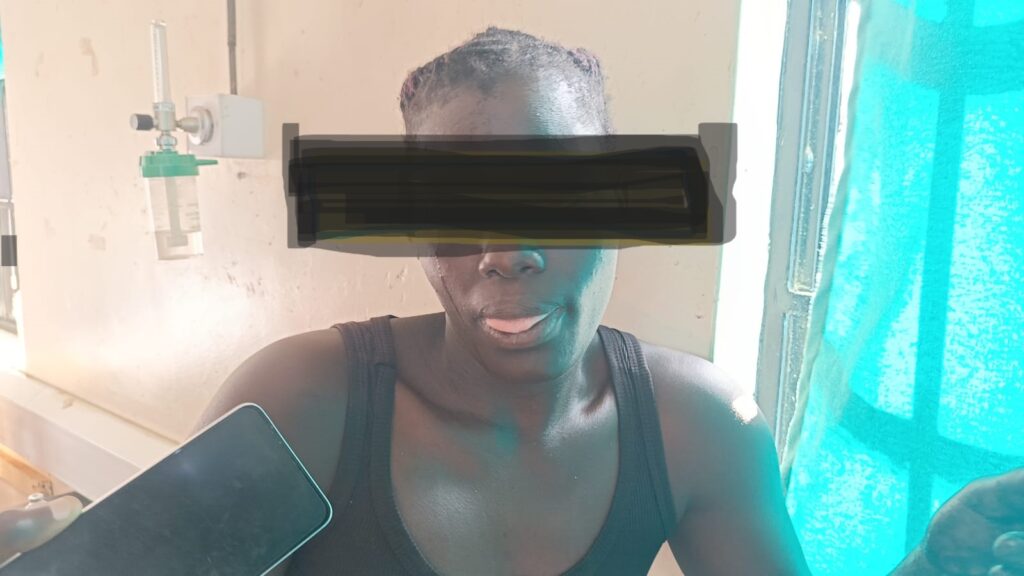
MIGORI: A 27-year-old mother of four from Migori County has detailed an harrowing account from her hospital bed a near-fatal domestic assault involving an acid and machete attack.
Sharon Eunice, in a chilling exposure of the escalating horrors of gender-based violence (GBV) in Western Kenya, recounted a pattern of systemic domestic abuse that culminated in a life-altering night of terror, leaving her permanently scarred and fearing for her family’s safety.
According to Eunice, the latest conflict escalated from a dispute over meager household finances.
After returning home from the local market with little earnings, she explained to her husband that she lacked the capital to restock her goods, chicken.
Rather than offering support, her husband delivered an ultimatum that she must immediately seek other sources of funds and ensure the business went on uninterrupted.
The situation turned catastrophic later that evening when her husband returned home; he locked up the children in the living room before pushing his wife into the bedroom.
What followed was a nightmare, he allegedly poured a bottle of chemical suspected to be an acid directly on her head before drawing a machete (panga) and slashing her repeatedly.
“I asked him, ‘Why are you killing me?'” she recounted with a trembling voice full of pain and anger.
Her narration sent chills to the journalists who had visited her.
“He had already hidden the weapon within the bedroom. It was a calculated trap,” she adds, writhing in pain.
As if that wasn’t enough, her assaulter, the man she devoted her life and body to for years, repeatedly subjected her to psychological torture by revisiting the past grievances and accusing her of belittling his family.
“This were meant to justify brutality towards me,” she adds with her eyeballs swollen with tears.
Failure of the local administration
What makes Eunice’s case particularly devastating is that the warning signs were clear, and administrative intervention had been formally sought.
Fearing for her life after receiving continuous death threats, she had previously reported her husband to the area chief.
The local chief reportedly ordered the husband to facilitate her transport back to her family.
Instead of complying with the administrative directive, the perpetrator defied the order, returned to the house, and subjected her to the near-fatal assault.
Eunice revealed that the hostility was deeply entrenched and often enabled by external family dynamics.
She recalled a previous incident where her husband assaulted her severely after her mother-in-law falsely accused her of wandering around the village instead of attending to her domestic duties, a common pattern where extended family members police a woman’s movements, stoking domestic tension and providing an implicit green light for violent control.
Call for justice
With the physical injuries, permanent disfigurement, and profound psychological trauma, Eunice called upon the Directorate of Criminal Investigations (DCI), human rights organizations, and the national government to intervene immediately.
With the suspect still at large and having previously threatened to commit suicide after taking her life, the family remains in an extremely vulnerable state.
“I am begging the government to help me get justice,” Eunice pleaded adding that “I need emergency security for myself and my four children. Right now, because of my extensive injuries, I cannot work, and my children cannot attend school regularly. We have been pushed completely to the brink.”
Worrying statistics
Sadly Eunice’s ordeal is a textbook manifestation of a widening national human rights crisis.
Across Kenya, gender-based violence continues to escalate from emotional abuse and financial control to physical mutilation and femicide.
Data from national health and demographic surveys paint a grim picture, indicating that nearly one-third of Kenyan women have experienced physical violence since the age of 15, most frequently at the hands of an intimate partner.
Public health and legal experts note that the systemic failure to protect victims often stems from the limitations of informal or localized interventions in rural contexts.
Administrative solutions frequently rely on issuing verbal warnings to perpetrators or advising temporary separation, however, without active police enforcement, immediate arrest protocols, or a secure safe-house infrastructure, victims who return to the home are routinely met with fatal retaliation from emboldened abusers.