
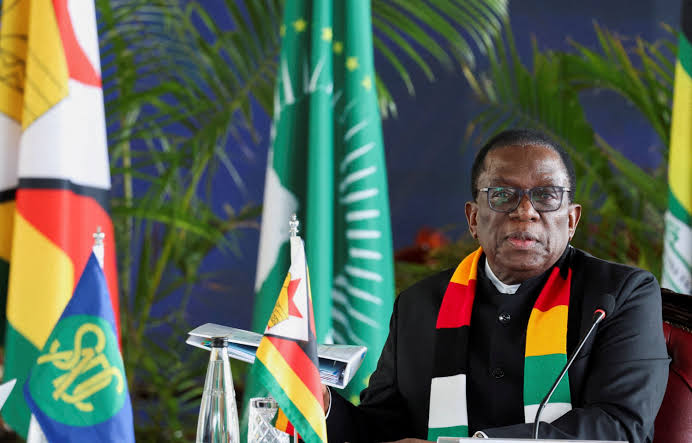
ZIMBABWE: In what appears to be a legislative overhaul that alters the country’s political landscape, Zimbabwean President Emmerson Mnangagwa has officially signed into law a highly controversial package of constitutional reforms.
The new legislation extends the presidential term from five to seven years and effectively cancels the direct, popular election of the head of state by the public.
The changes, contained within the newly gazetted Constitutional Amendment (No. 3) Act, were formally confirmed on Tuesday by Nick Mangwana, Zimbabwe’s Permanent Secretary for Information, Publicity, and Broadcasting Services.
By extending the concurrent mandates of the presidency, parliament, and local government bodies, the legislation pushes the country’s next general election cycle, previously slated for 2028, out to the year 2030.
This extension ensures that the 83-year-old Mnangagwa, who has ruled the country since a 2017 military-backed coup, will legally remain in power until the turn of the decade.
No more universal suffrage for presidency
The most polarizing pillar of the amendment package is the total abolition of direct presidential voting by Zimbabwean citizens.
Going forward, the heavy responsibility of selecting the president has been entirely transferred to Members of Parliament.
Under the new framework, a joint sitting of the National Assembly and the Senate will cast ballots to determine the head of state.
Political analysts note that this systemic shift fundamentally alters future paths to executive power: the ruling ZANU-PF party maintaining a commanding legislative majority, bolstered by a heavily criticized 2022–2023 boundary delimitation process, the prospects of an opposition leader scaling to the presidency have been drastically diminished for the foreseeable future.
Secondly, the new law effectively short-circuits the long-rumored presidential ambitions of Vice President General Constantino Chiwenga through standard electoral means.
By binding the presidency to a parliamentary vote, the amendments leave any prospective leadership change heavily dependent on internal ZANU-PF party machinery.
Total restructure
Beyond shifting term limits and voting mechanisms, the Amendment Act introduces structural adjustments to the state’s judicial and electoral organs.
The law strips public interview requirements for senior judicial promotions and splits the Supreme Court by introducing a new Judge President position.
Furthermore, the statutory duties of managing voter registration and compiling the national voters’ roll have been taken away from the independent Zimbabwe Electoral Commission (ZEC) and returned to the executive-controlled Registrar-General’s office.
Boundary-mapping responsibilities will now fall under a newly formed, executive-appointed Zimbabwe Electoral Delimitation Commission.
The government has vigorously defended the amendments as a necessary mechanism to cure chronic “election-related toxicity” and to grant the administration sufficient, uninterrupted time to execute its long-term socio-economic master plan, Vision 2030.
Legal scholars, civil society groups, and opposition leaders, however, have roundly condemned the move, labeling it a “constitutional coup” designed to dismantle democratic safeguards and entrench one-party rule.
Prominent constitutional defenders have already signaled intentions to challenge the legality of the transition framework before the country’s apex Constitutional Court.