
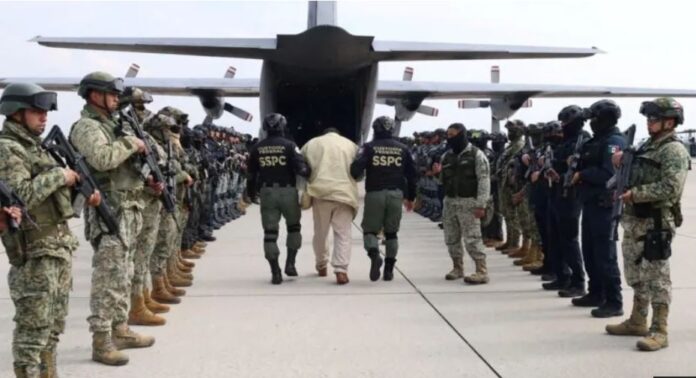
On the anniversary of Donald Trump’s return to the White House, Mexico has delivered a massive “offering” to the north: 37 high-profile cartel members flown out on armed military aircraft.
While Mexican Security Secretary Omar García Harfuch frames the move as a strategic win for domestic safety, the timing suggests a deeper, more desperate geopolitical calculation.
This is the third major handover in just one year, bringing the total number of high-impact criminals sent to American soil to 92 under the administration of President Claudia Sheinbaum.
This surge in cooperation is no coincidence; it is a direct response to a tightening vise of American pressure.
Earlier this month, President Trump chilled regional leaders by suggesting that after successfully “knocking out” maritime trafficking, the U.S. would now “start hitting land” to exterminate the gangs he claims are “running Mexico.”
Coming on the heels of the dramatic U.S. military operation that seized former Venezuelan President Nicolás Maduro from Caracas, these threats carry a new, terrifying weight.
For Sheinbaum, the mass extraditions serve as a vital pressure valve, an attempt to prove that Mexico can police its own borders before Washington decides to do it for them.
The logistical scale of this latest transfer—spanning destinations from New York to San Antonio—underscores a shift in how Mexico handles its most dangerous inmates.
By leveraging a 2025 National Security Law that allows the government to bypass the often-glacial pace of traditional extradition treaties, Sheinbaum is moving with unprecedented speed.
She has defended the policy as a “sovereign decision” made in Mexico’s best interest, citing a 50% drop in fentanyl seizures at the border as proof that her “cool-headed” crackdown is working.
However, the optics remain a challenge for a leader who promised to maintain national dignity. While Harfuch secured a commitment from the U.S.
Justice Department to waive the death penalty for the 37 detainees, critics argue that the sheer volume of these transfers looks less like a partnership and more like a tactical retreat.
As President Trump continues to float the possibility of land strikes and troop deployments, Mexico finds itself in a high-stakes game of chess.
For now, the Sheinbaum administration is hoping that by handing over the kings and pawns of the cartels, they can save the board, and their sovereignty, from a much more violent intervention.


