
The political direction of the Luo community in Nyanza has often revolved around questions of loyalty, ideology, development, and succession.
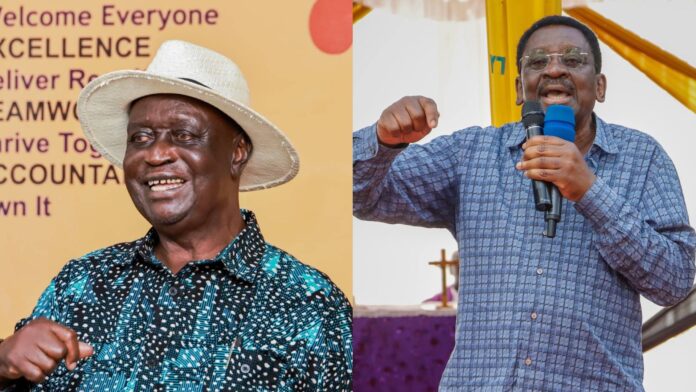
In the current political climate, two senior figures stand out in shaping the conversation; Siaya Governor James Orengo and senator Oburu Oginga.
Both are seasoned politicians with long histories in Kenya’s democratic journey, yet they represent distinct approaches to leadership and the future of the region.
The question many are quietly asking today is: In whose hands is the Luo community safer, both politically and economically?
Governor James Orengo represents constitutionalism, independent political thought, and a commitment to institutional democracy.
For decades, Orengo built his reputation as a fearless defender of civil liberties, dating back to the days of the “second liberation.”
Even his critics admit he has remained ideologically consistent.
Governor Orengo’s punchline
As the Governor of Siaya, Orengo has positioned himself as a leader unafraid to speak uncomfortable truths, even when they misalign with the dominant political currents of the opposition.
Recently, Orengo has appeared cautious regarding “blind” political alignments, specifically the broad-based arrangements between opposition figures and the Kenya Kwanza administration.
To many Luo professionals and young intellectuals, this signals maturity and strategic foresight.
They see him as a shield, protecting the community from being swallowed by short-term political deals that may lack long-term benefits.
His supporters argue that the Luo community has historically suffered whenever it abandoned issue-based politics in favor of emotional political waves.
However, Orengo is not without his detractors; some believe his brand of politics is too intellectual and detached from grassroots realities.
Others fear that his constant critique of political arrangements may isolate the community from national power-sharing opportunities.
In Kenyan politics, access to the executive often translates to development resources, appointments, and economic influence.
Critics argue that while Orengo may stand on principle, politics also requires practical engagement.
Senator Oburu’s bone
On the other hand, Senator Oburu represents continuity, experience, and political pragmatism.
As the elder brother of Raila Odinga and son of Jaramogi Oginga Odinga, the lawmaker (ODM party boss) carries enormous historical and emotional weight within Nyanza.
His politics are rooted in loyalty to the Odinga tradition, which has dominated the region’s landscape for decades.
Supporters of Oburu believe his approach guarantees political stability.
They believe that isolation from the government has historically disadvantaged Nyanza economically; therefore, engagement with the national government is a necessity, regardless of political differences.
Dr Oburu’s camp views cooperation, negotiation, and maintaining strong ties with national leadership as the safest route toward development and inclusion.
Yet, critics warn that “loyalty politics” may weaken democratic accountability.
A growing cohort of young voters feels that Luo politics has become too centered on personalities and family influence rather than policy and generational renewal.
They fear that unquestioning political unity can silence constructive criticism and stifle healthy political competition within the region.
Where the Rivers meet
The reality is that both leaders symbolize competing, yet necessary, philosophies; Mr Orengo represents ideological independence, while Oburu represents unity and strategic accommodation.
The Luo community currently faces significant challenges: youth unemployment, economic stagnation, and a declining faith in traditional politics.
These issues require both principled leadership and practical negotiation. Perhaps the community’s safety does not lie with a single leader, but in a balance of these two strengths:
As Nyanza transitions into a new political era, the community may increasingly demand leaders who can combine integrity with development-focused governance.
The future of Luo politics may not belong to one camp alone, but to those capable of uniting principle with pragmatism.