
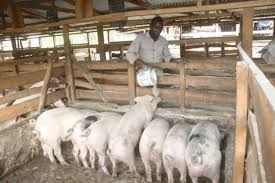
By MITCHELL MAINGI: For many years, pig farming sat quietly on the margins of Kenya’s agricultural landscape; while cattle symbolized wealth and goats defined resilience, pigs were often overlooked and seen as unfamiliar and, in some communities, culturally or religiously sensitive.
Today, however, that narrative is shifting.
Agriculture remains the backbone of Kenya’s economy, with crop farming leading the way and livestock providing livelihoods for millions.
Within the livestock sector, dairy and beef cattle dominate, followed closely by sheep, goats, and poultry.
By comparison, pig farming has long been a minor player; yet, beneath the surface, a quiet transformation is taking place.
A late arrival
Unlike cattle or goats, pigs were not traditionally kept by most Kenyan communities.
The practice was introduced during the colonial period by European settlers and Asian communities, remaining largely confined to mission centers and towns.
After independence, pig farming spread slowly.
Growth was heavily restricted by cultural attitudes, religious beliefs, weak market structures, and a lack of technical extension services.
For decades, keeping pigs remained a backyard activity rather than a serious commercial enterprise.
The turning point came over the last two decades, driven by rapid growth around urban centers. Rising urban populations, changing dietary preferences, and a search for faster income streams have pushed a new generation of farmers, particularly the youth, to reconsider the pig.
Pigs grow fast, reproduce quickly, and require significantly less land than cattle.
A pig can reach market weight in just five to six months, compared to the years it takes for a beef cow to mature.
For young farmers with limited land and capital, this rapid turnaround matters immensely.
Today, it stands as one of the fastest-growing minor livestock sectors in the country.
A major catalyst for this growth has been the role of formal processors, chief among them Farmer’s Choice, Kenya’s leading pork processor.
“Many Kenyans prefer beef and chicken to pork, which is actually an excellent and affordable source of protein. Pigs are just like any other livestock; they are fed with quality feeds and kept in a hygienic environment,” says Laban Kabiru, General Manager at Farmer’s Choice.
He notes that local consumption is on the rise, “resulting in numerous pork butcheries popping up in most shopping centers.”
The processor typically buys pigs at 70kg to 90kg live weight, paying per kilogram.
A well-managed pig can net a farmer between Sh5,000 and Sh12,000 profit, depending on feed costs and management efficiencies.
For a small-scale farmer, securing this kind of return within half a year can be life-changing.
“Pig farming is highly profitable if you are prepared to handle the challenges that come with the venture,” says Catherine Njoki, a pig farmer in Busia.
“Pigs are highly versatile and can utilize various feed resources, which provides some relief when managing costs.”
In Kiambu County, Paul Kimani, a youth farmer, highlights the local retail market’s potential.
“A kilo of pork goes for around Ksh 400 in the butchery, and a mature pig can sell for Ksh 30,000 to Ksh 40,000 depending on its size.”
The future
Still, the venture is not without its hurdles; feed costs remain the single biggest challenge, consistently cutting deeply into profit margins.
Secondly, disease control (like African Swine Fever), strict housing standards, and meeting the stringent quality requirements of major processors demand high discipline and technical knowledge.
Furthermore, while pork consumption is growing, it still faces stiff competition from beef and chicken.
Compared to dairy farming, which offers stable, long-term income but requires heavy initial capital investment, pig farming offers speed and liquidity.
Again, compared to poultry, pigs offer higher returns per animal, albeit with a slightly different risk profile.
What was once a neglected backyard enterprise is fast becoming a sophisticated business.
Supported by formal processors, propelled by urban demand, and embraced by a new generation of agripreneurs, pig farming is confidently carving out its own space in Kenya’s modern agricultural story.