
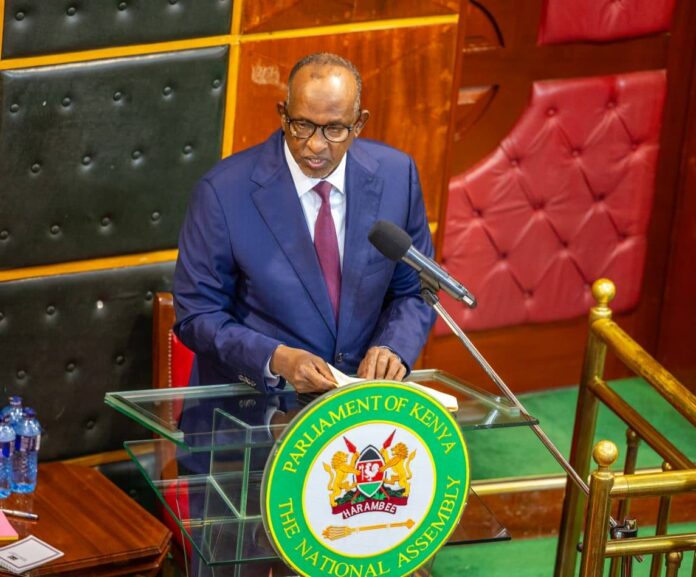
Health Cabinet Secretary Aden Duale has strongly defended the government’s aggressive Ebola preparedness measures, asserting that the state is under no legal obligation to conduct public consultations when responding to urgent public health threats.
Speaking before Parliament on Wednesday, Duale maintained that delaying critical interventions to seek public feedback would expose the country to catastrophic risk.
“We are not going to consult citizens. Under the Public Health Order, it does not require any consultation,” Duale told lawmakers.
“God forbid if Ebola is in the country, this House will call me back here.”
The health boss emphasized that the Ministry of Health possesses both a moral and constitutional responsibility to safeguard the lives of Kenyans, as well as transit travelers moving through the country.
The policy stance comes as Kenya intensifies its defensive measures following an Ebola outbreak in neighboring Uganda and a wider regional threat stemming from an ongoing outbreak in the Democratic Republic of Congo (DRC).
To mitigate the risk of cross-border transmission, the Ministry of Health has rolled out a comprehensive emergency response strategy which includes, tightening protocols at airports and land borders, enforcing strict health declaration requirements, temperature checks, symptom assessments, and clear referral tracks.
There are also established thermal scanners and holding rooms are being actively reviewed and deployed.
There are further four specialized laboratories designated for rapid Ebola testing, these include the National Public Health Laboratory, KEMRI facilities in Nairobi and Kisumu, and a strategically placed mobile laboratory to support border regions.
To tighten the prevention, the World Health Organization (WHO) has supplied Kenya with 1,000 Ebola personal protective equipment (PPE) kits, which are currently being prepositioned at high-risk entry points.
Danger Zones
The Ministry of Health has officially mapped out the country’s vulnerability, categorizing 25 counties based on their proximity to borders or transit volume: Nairobi, Mombasa, Uasin Gishu, Busia, Kisumu, Bungoma, Trans Nzoia, Siaya, West Pokot, Turkana, Homa Bay and Migori are categorised as very high risk regions.
Vihiga, Kakamega, Nakuru, Kericho, Nandi, Kiambu, Machakos, Makueni, Kilifi, Taita Taveta, Isiolo, Elgeyo Marakwet, and Garissa counties have been mapped as high risk areas.