
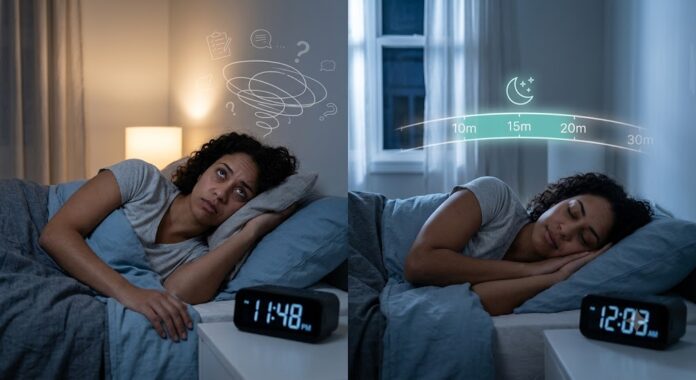
If you have ever stared at the ceiling wondering why your brain refuses to shut off, or conversely, if your head hits the pillow and you instantly lose consciousness, you are experiencing the realities of sleep latency.
Simply defined by sleep specialists, sleep latency is the exact amount of time it takes you to transition from full wakefulness into the initial stages of sleep.
While many people assume that falling asleep the absolute second their eyes close is a sign of superior health, behavioral sleep medicine experts suggest otherwise.
In reality, there is a specific, healthy time window for drifting off, and straying too far toward either extreme can serve as a warning sign for underlying health issues.
According to Dr Michelle Drerup, a behavioral sleep medicine specialist at the Cleveland Clinic, a healthy person should generally take about ten to twenty minutes to fall asleep.
Dr Drerup emphasizes that faster is not necessarily better; passing out within a single minute of getting into bed is often a red flag for chronic sleep deprivation or an exhaustion-driven sleep debt rather than a sign of perfect sleep hygiene.
While this ten-to-twenty-minute timeframe serves as an excellent general guideline, it naturally varies from person to person.
A fluctuating sleep timeline only shifts from a minor annoyance into a clinical problem when it actively robs you of enough total rest or begins causing you significant psychological stress and anxiety.
When sleep latency is drastically skewed, it is often tied to specific, underlying medical conditions that disrupt the central nervous system’s ability to regulate rest.
Insomnia
One of the most common culprits behind a prolonged sleep latency is chronic insomnia, a condition that keeps the brain in a state of hyperarousal and makes crossing the threshold into sleep incredibly difficult.
Physical discomforts, such as Restless Legs Syndrome, also delay sleep onset by creating an irresistible urge to move the limbs right as the body attempts to relax.
On the flip side, individuals suffering from untreated sleep apnea often exhibit a drastically shortened sleep latency.
Because their nighttime breathing is constantly interrupted, they live in a state of profound, chronic exhaustion, causing them to fall asleep almost instantly whenever they sit or lie down.
Fortunately, if you find yourself struggling to hit that healthy ten-to-twenty-minute window, there are several evidence-based strategies you can implement to retrain your biological clock.
Sleep specialists recommend anchoring your internal schedule by waking up and going to bed at the exact same time every day, even on weekends.
Crucially, Dr Drerup stresses that you should never force yourself into bed when you are wide awake; instead, only get under the covers when you are actually feeling physically drowsy or heavy-eyed.
Additionally, engaging in regular daytime exercise and strictly avoiding caffeine or heavy stimulants in the evening can significantly improve your body’s natural sleep readiness.
Ultimately, if your struggles with falling asleep begin to negatively impact how you feel, think, or function during the day, it is highly recommended to seek the guidance of a certified sleep specialist.