
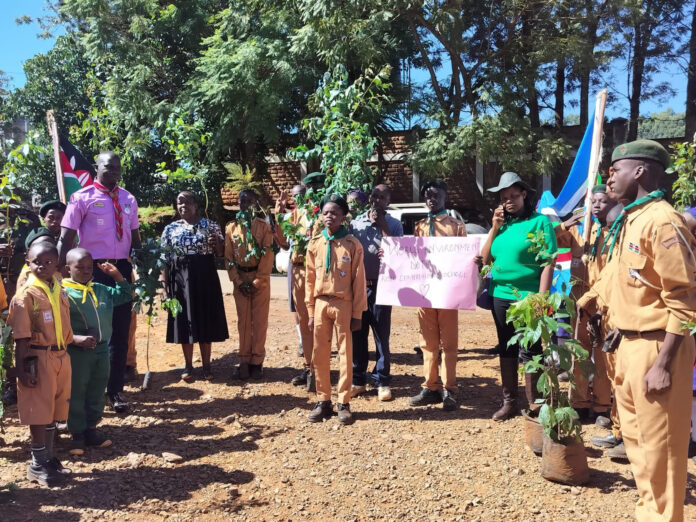
Kisii National Polytechnic has renewed her commitment to environmental conservation through an ambitious afforestation program designed to greatly boost forest cover across the region.
Speaking during World Environment Day celebrations at Kisii Comprehensive School, the institution’s Greening Champion, Tabitha Nchobera, revealed that the polytechnic has already surpassed its initial annual performance contracting target of 14,900 trees.
“In our college, we had a performance contracting target of 14,900 trees, which we have already achieved,” Nchobera stated, noting that the Ministry of Environment subsequently revised the institution’s target upward to 30,000 trees.
The polytechnic has moved to meet the new directive.

“We were given an expanded target of 30,000 trees, and we have already planted 4,000 at Otacho Forest in Migori County and today, we have also donated 3,500 seedlings here to Kisii Comprehensive School,” she said.
Nchobera added that the institution will continue distributing seedlings to schools across Ibeno Ward and encouraging staff members to champion tree-growing initiatives at home to help the region achieve critical forest cover thresholds.
While praising the college management for establishing a dedicated nursery to propagate indigenous, exotic, and fruit tree seedlings, Nchobera appealed for external partnerships to scale operations.
“If we get partners to collaborate with us so that we can produce more seedlings, we can expand our reach significantly,” she added.
The greening campaign has also found a strong anchor in the student body.
Byron Odhiambo, an engineering student at the polytechnic, emphasized that young people are actively driving grassroots conservation efforts.
“We are the greening ambassadors giving back to the environment. We want to nurture our surroundings and keep them clean and green,” Odhiambo said, urging the wider public to support local climate action.
However, the student ambassador noted that environmental initiatives face real-world climate obstacles, particularly prolonged dry spells that threaten sapling survival rates.
“Sometimes we plant trees and a long drought follows. The trees end up drying up, which is one of our primary challenges,” Odhiambo explained.
He further noted that resource constraints can complicate the maintenance of the tree nurseries when students are fully occupied with their academic calendars.