
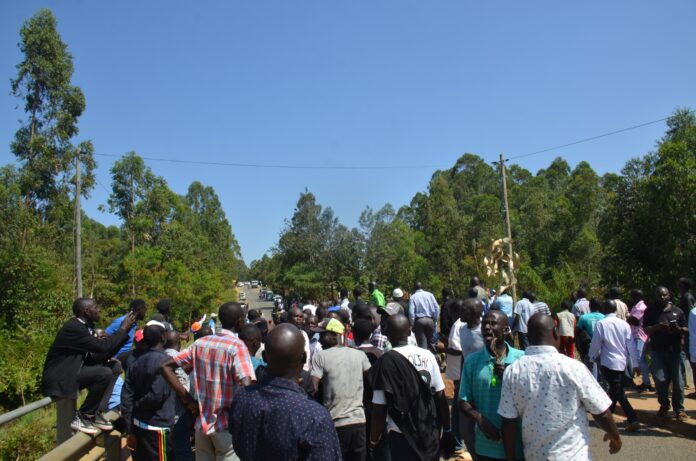
Business activities along the busy Migori–Isebania highway ground to a halt today after matatu operators and local traders blocked a key diversion created to bypass the damaged Migori town bridge.
The demonstration has sparked widespread gridlock and disrupted cross border trade, with local stakeholders expressing deep frustration over the government’s perceived inaction.
George Rarieda former Chairman of Migori Matatu Association accused both national and county authorities of negligence, citing prolonged uncertainty surrounding the repair and safety of the bridge. He issued a strict ultimatum to both the national and county governments, declaring that the local population has had “enough” of administrative neglect.
“We have written reports, we have attended meetings, and we have made requests,” Rarieda sharply criticized. “Yet, there is no roadblock sign, no construction team, and no emergency bridge. The community cannot continue to suffer while the authorities look the other way.”
According to the operators, no senior government official has visited the site to provide a definitive timeline or address their mounting safety concerns.
Furthermore, local traders directed their anger at the Migori County Government, criticizing the devolved unit for continuing to collect daily market cesses and taxes despite the severe business disruptions caused by the impassable road network.
“We cannot keep paying taxes when the infrastructure supporting our livelihood is falling apart, and nobody seems to care,” lamented one of the local traders.
Economic paralysis and rising costs
The broken bridge, which serves as a vital artery for the region’s commerce, has effectively cut off main transport routes for months, bringing local businesses to a standstill. For Migori’s public transport sector, the closure isn’t a political talking point it is financial ruin.
According to transport operators, the closure has forced motorists including matatus, boda bodas, and Probox taxi drivers to utilize lengthy, poorly maintained bypasses.

This diversion has significantly driven up fuel consumption and vehicle maintenance costs, a burden that is ultimately being passed down to heavily strained commuters.
“Every day this bridge remains broken, our traders lose money, and our vehicles are ruined by long bypasses,” lamented one of the transport representatives. “We are buying more fuel just to cover short distances because the primary route is completely dead.”
In an act of defiance, the operators threatened to forcefully reopen the condemned main bridge to traffic, declaring that they would rather let it collapse under use if that is the only language that will compel the authorities to act.
Broken promises and postponed protests
The chaotic scene unfolded just a day after local civil society organizations (CSOs) had agreed to shelve a similar planned protest.
Following a high-level meeting yesterday involving the Migori County Commissioner and representatives from the Kenya National Highways Authority (KeNHA), the CSOs had agreed to suspend their demonstrations to allow room for dialogue.
However, that diplomatic reprieve proved short lived, as the matatu operators and disgruntled business owners took matters into their own hands this morning, demanding immediate action rather than endless boardroom discussions.
They have promised to go for peaceful protest every Friday until the involved sectors take an action of constricting the bridge
By midday, transport along the international highway remained severely crippled, with long queues of vehicles including transit trucks heading to the Sirare-Isebania Tanzania border stuck on both sides of the town.