
BY AUSTINE OGOLA: The recent vote on the Finance Bill 2026 has reignited an important national conversation: Does Kenya need as many elected leaders as it currently has?
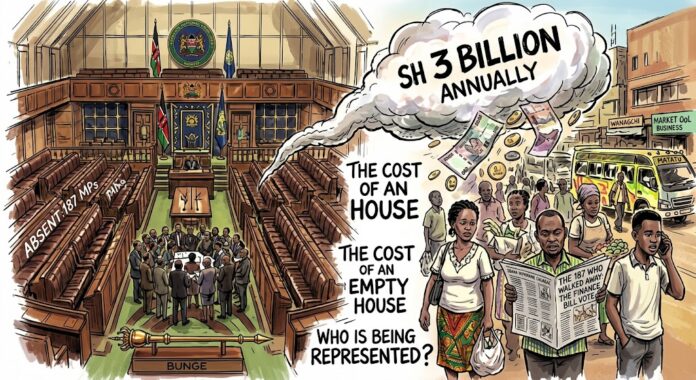
Out of the 349 Members of the National Assembly, only 162 participated in one of the most consequential votes of the year.
Of these 122 voted in favour of the Bill while 40 voted against it. This means that 187 MPs more than half of the House did not participate in the final decision.
Yet all 349 MPs are maintained at the taxpayer’s expense.
Based on current remuneration rates, Members of Parliament collectively earn more than KSh 3 billion annually in salaries alone.
When allowances, committee sitting allowances, transport benefits, medical cover, office operations, staff support, security, and other taxpayer-funded benefits are included, the total cost rises substantially.
Half house
The Finance Bill vote raises a fundamental question: If only 162 MPs can make decisions that affect over 50 million Kenyans, why are taxpayers funding 349 MPs?
This is not an attack on democracy or representation. Rather, it is a call for efficiency and accountability. Kenya must begin an honest conversation about whether its governance structure has become unnecessarily large and expensive.
The 2010 Constitution introduced devolution to bring services closer to the people, a goal that has largely been achieved. However, it also created additional layers of leadership at both the national and county levels.
Today, the country supports a President, Deputy President, Governors, Deputy Governors, Senators, Women Representatives, Members of Parliament, Members of County Assemblies, County Executive Committee Members, Chief Officers, advisers, and numerous other public offices.
While each office may have been created with good intentions, the cumulative cost of maintaining this expansive leadership structure has become enormous.
At a time when Kenyans are grappling with a high cost of living, unemployment, and increasing taxation, it is only fair to ask whether the country is receiving value for money.
The issue is not merely attendance in Parliament. It is about the overall cost of governance. Every shilling spent on maintaining an oversized political structure is a shilling that could otherwise be invested in healthcare, education, water projects, roads, agriculture and job creation.
Few committed lawmakers
The recent Finance Bill vote demonstrates that parliamentary business can proceed with far fewer members than the current composition of the House.
It therefore presents an opportunity for Kenya to review the size of Parliament, the necessity of some elective and nominated positions, and the broader structure of government.
As the nation continues to seek solutions to its economic challenges, reducing the cost of governance should be part of the discussion. Leadership should be measured not by the number of offices we create, but by the quality of services delivered to wananchi.
The question facing Kenya today is simple: Can we continue justifying the cost of maintaining hundreds of leaders when fewer than half participate in some of the most important decisions affecting the nation?
It is time for a serious national debate on the size, cost, and effectiveness of leadership in Kenya.
Mr Austine Ogola comments on political matters, he serves as a senior communications officer in Siaya County