
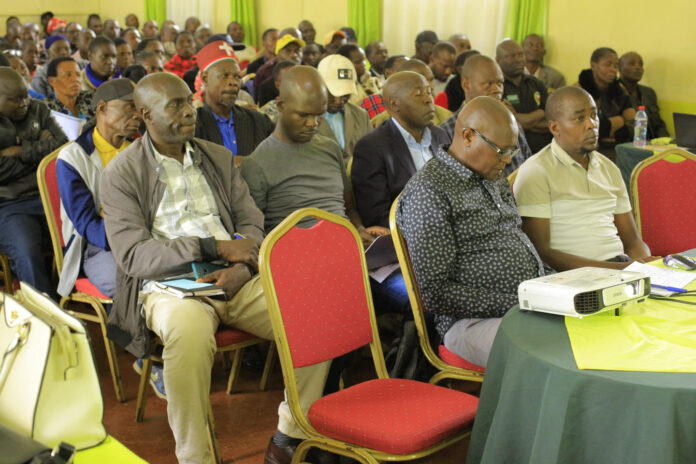
The State Department for Mining has launched nationwide public participation forums on three foundational policy and legislative documents aimed at modernizing Kenya’s extractive sector, upgrading worker safety standards, and positioning the country to attract higher foreign direct investment.
Speaking during the regional forum, Principal State Counsel Patricia Mabil, deployed to the State Department for Mining from the Office of the Attorney General, emphasized that the comprehensive stakeholder engagement fulfills a constitutional mandate requiring the state to collect and incorporate public views before any regulatory framework is enacted into law.
Chief among the legislative revisions is the proposed Explosives Bill, which is designed to entirely replace the current, obsolete law that has governed the sector for nearly a century.
Outdated Mining policy
“The initial Explosives Act was enacted way back in 1931,” Mabil stated further noting that, “It is now 95 years old, and it is long overdue for us to completely overhaul it so we can align our regulations with the massive technological and security changes that have occurred globally over the decades.”
Beyond the explosives legislation, Mabil revealed that the second document up for stakeholder review is the revised Mining and Minerals Policy, updating the original guidelines introduced in 2016.
She noted that the macro-policy has hit its ten-year milestone, necessitating a strategic review to address emerging market trends, green energy transitions, and local community shareholding models.
The third document under review comprises the comprehensive Mine Health and Safety Regulations, which are intended to enforce strict safety and health protocols across all artisanal and large-scale mining operations.
Echoing the importance of civic engagement, Dr Julie Oseko, the Vice Chairperson of the National Land Commission (NLC) and a member of the Mineral Rights Board, noted that the exercise grants citizens and local communities a direct voice in shaping resource governance laws.
“One of our primary objectives is to sit on the ground and listen to the public’s views as these respective bills and regulations are being structured,” Dr Oseko said.
She added that the Mineral Rights Board is heavily focused on ensuring Kenya’s regulatory landscape becomes highly competitive and transparent to unlock stalled capital investments in mineral exploration.
Nyamira County Mining Committee Chairperson Robin Achoki welcomed the state’s decentralized approach, noting that the capacity-building forum would help newly appointed regional oversight teams properly interpret and implement the incoming statutory adjustments.
“Today’s session allows us to fully deconstruct and appreciate what these legislative proposals entail,” Achoki remarked.
“This is the very first time the County Mining Committee has been formally constituted and operationalized, meaning we have an extensive amount to learn and put into practice to safeguard both our miners and our local revenue streams.”