

Hundreds of thousands of parents and 2025 Kenya Certificate of Secondary Education (KCSE) candidates across the country can finally breathe a sigh of relief.
The Ministry of Education, in coordination with the Kenya Universities and Colleges Central Placement Service (KUCCPS), has officially released the placement results for the 2025/2026 higher education cycle.
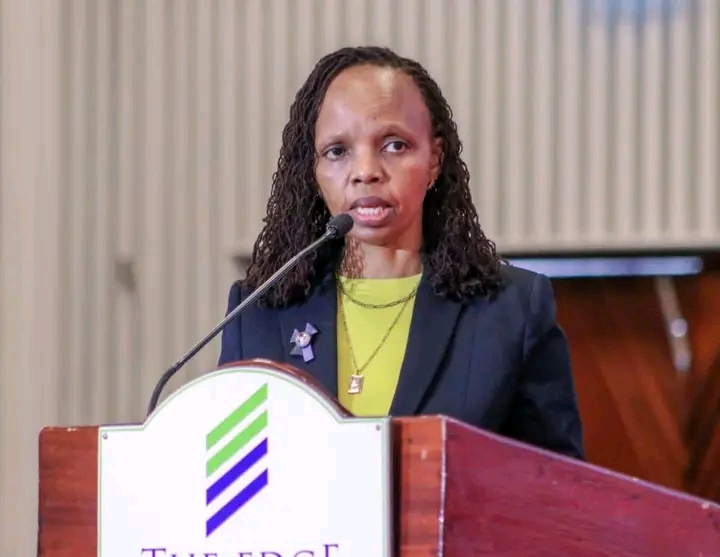
Education Cabinet Secretary Julius Ogamba and KUCCPS Chief Executive Officer Agnes Mercy Wahome unveiled the findings, detailing a massive scaling-up of centralized admissions where a total of 293,869 students have been successfully placed into various degrees, diplomas, certificates, and artisan programs nationwide.
The sheer scale of this year’s placement exercise is unprecedented.
Over 250,000 students secured university entry grades
Out of the 980,535 candidates who sat for the 2025 KCSE examination and were eligible for selection, 270,508 achieved the minimum university entry grade of C-plus or higher.
The placement process actively absorbed 81 percent of those qualifying with a C-plus and above, following a rigorous review across multiple application and revision windows that closed in late May.
While degree slots were heavily sought after, total institutional capacities actually surpassed overall applicant numbers, showcasing a vast expansion across the academic landscape.
Forty-three public and 31 private universities declared a combined pool of 322,396 degree slots, meaning there were more than enough physical vacancies to comfortably accommodate all university-eligible candidates, while Technical and Vocational Education and Training (TVET) institutions opened their doors wider than ever before by registering a combined capacity of 1,132,531 trainee slots.
The final placement metrics indicate a massive distribution of students across classic academic fields alongside significant structural expansions.
The vast majority of applicants, totaling 202,133 students, secured slots in degree programmes distributed across both public and private universities determined strictly by student merit and specific course cluster weights.
The Kenya Medical Training College absorbed 28,246 students, cementing its status as one of the most heavily requested and competitive options on the portal.
Meanwhile, Kenya Utalii College made history by being integrated into the centralized KUCCPS system for the first time, successfully admitting 765 students into its hospitality and tourism courses.
Preference to TVETs
A significant structural shift was observed as 8,915 degree-qualified students who scored a C-plus or higher voluntarily opted to bypass university to pursue skills-based courses at TVET institutions instead.
Additionally, specialized professional tracks saw 875 students allocated to secondary education programs at Teacher Training Colleges, while another 500 students were assigned to specialized Diploma in Law paralegal programs.
Cabinet Secretary Ogamba noted that seeing nearly 9,000 students who qualified for direct university degree tracks voluntarily choose the TVET pathway proves that a highly encouraging mindset shift is occurring among young people, validating the national message that technical craftsmanship serves as an engine of the economy.
Despite massive structural capacities overall, demand continues to intensely outstrip space in specific elite courses. For example, 6,500 students applied for Bachelor of Medicine programmes, yet the collective maximum capacity across all accredited universities stood at just 702 slots.
High competition
High-tier fields like Nursing, Pharmacy, and Engineering were similarly filled to capacity within the first phase of selection.
Dr Wahome explained that this intense competition highlights a critical reality where professional courses regulated by bodies like the medical council remain strictly limited by physical infrastructure, hospital placement limits, and staff-to-student ratios, urging applicants to look broadly at alternative health sciences.
To curb student frustration and give families ample time to adjust to their institutional assignments, the Ministry announced a crucial policy amendment extending the inter-institution transfer window from the standard two weeks to one full month.
This extension is explicitly targeted at giving families sufficient room to calculate financial logistics or request placement adjustments based on geographical proximity, fee structure constraints, or program alternatives.
Furthermore, CS Ogamba issued a direct mandate to all university vice-chancellors and college principals to immediately draft and dispatch formal admission letters and comprehensive joining instructions, allowing families to plan accommodations and complete physical registrations well ahead of the upcoming academic year.
Parallel to the release of the placement results, the Ministry of Education officially opened up state funding channels to support the incoming cohort.
For first-time undergraduates assigned to public universities and technical colleges, the Higher Education Financing portal is now live, allowing students to apply for both government scholarships and student loans under a variable funding model determined strictly by financial need.
Higher Education Loans Board
However, it is important to note that students placed in private universities remain eligible to apply for Higher Education Loans Board (HELB) student loans but do not qualify for direct government scholarships.
Concurrently, HELB has opened up applications for Undergraduate Subsequent Loans, ensuring that continuing student cohorts face zero disruption in their ongoing tuition funding.
In light of the results release, KUCCPS has strongly warned families to monitor official digital spaces closely and avoid falling victim to third-party cyber scams.
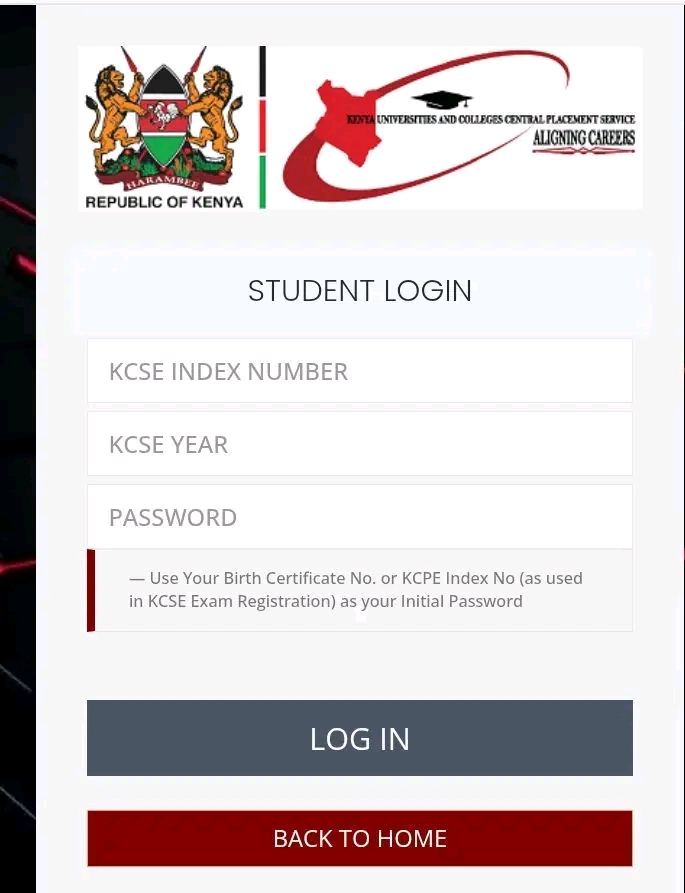
To securely view a placement outcome, applicants must log into the official KUCCPS Students Portal at students.kuccps.net and click on the designated login tab.
From there, credentials must be input using the portal’s specific format, which requires entering the official KCSE Index Number as the username, setting the application year as 2025, and using either a Birth Certificate Number or a KCPE Index Number as the password for first-time users.
Once logged in, the student dashboard will explicitly display the allocated institution, assigned campus, and designated academic programme.
For certain student categories, KUCCPS is also rolling out automated SMS notifications sent directly to the phone numbers registered during the portal revision windows.