
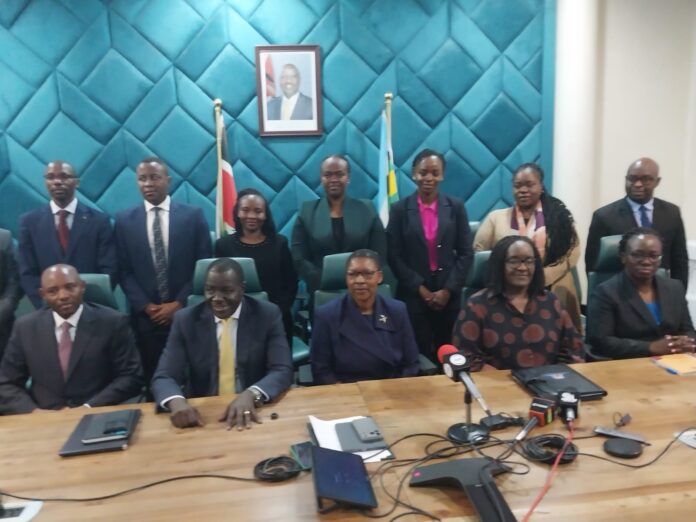
BY CHARLES WASONGA: Attorney General Dorcas Oduor has announced that her office will present a comprehensive statutory reform report to Parliament aimed at amending, repealing, or aligning invalidated laws before the House adjourns sine die ahead of the 2027 General Elections.
Speaking at Sheria House in Nairobi, the Attorney General unveiled a multi-sectoral committee tasked with auditing Kenya’s statute books to purge laws that remain physically printed in statutory texts despite being struck down by the courts.
The multi-sectoral committee is chaired by Kenya Law Reform Commission (KLRC) Chairperson Christine Agimba and draws expertise from government ministries, the Judiciary, Parliament, the Office of the Attorney General, and the KLRC.
Addressing the media, Attorney General Oduor emphasized that while judicial decisions under Article 2(4) of the Constitution immediately render inconsistent laws null and void, court judgments do not automatically edit or excise text from the official laws of Kenya.
Existing legislative texts
She noted that dozens of provisions struck down by the Judiciary remain intact in legislative texts simply because follow-up legislative action was never completed.
According to the Attorney General, this systemic mismatch creates legal uncertainty, generates implementation bottlenecks for government institutions, and exposes the State to costly, avoidable constitutional disputes while hindering the seamless delivery of justice to citizens.
To resolve these legislative gaps, the newly formed committee has outlined a clear three-phase execution roadmap over the next six months.
During the first three months, the team will undertake preliminary review work and actively collect views and proposals from the public, civil society, and legal stakeholders.
The subsequent three months will focus on conducting the comprehensive technical audit of unconstitutional and outdated statutes to draft the necessary repeal and alignment Bills.
Ultimately, at the six-month mark, the Attorney General’s office will submit the final reform report and omnibus legislative package directly to Parliament for formal debate and passage.
Need fr audit
The necessity of the Attorney General’s audit initiative is highlighted by past landmark rulings where key statutory amendments were declared unconstitutional but remained embedded in physical legal texts.
A vivid example occurred in February 2015, when a five-judge bench of the High Court struck down eight key sections of the controversial Security Laws (Amendment) Act of 2014 for violating fundamental rights, including media freedom, fair trial guarantees, and international treaty obligations.
Among the invalidated provisions was Section 12, which amended the Penal Code to criminalize publishing material likely to cause fear and alarm, a measure the court found severely curtailed freedom of expression and media freedom.
The court also invalidated Section 16 and Section 20, which infringed on fair trial rights by allowing prosecutors to withhold crucial evidence from defense teams and expanding the use of improperly obtained evidence in trials.
Furthermore, Section 26 was overturned for arbitrarily restricting an accused person’s right to bail, while Section 34 was annulled for granting the Executive unchecked powers to declare public gatherings illegal.
The High Court ruling also struck down Section 48 for unconstitutionally capping refugee numbers in violation of international non-refoulement obligations, Section 64 for banning media coverage of security operations or casualties without police permission, and Section 95 for compromising an accused person’s right to confront state witnesses.