
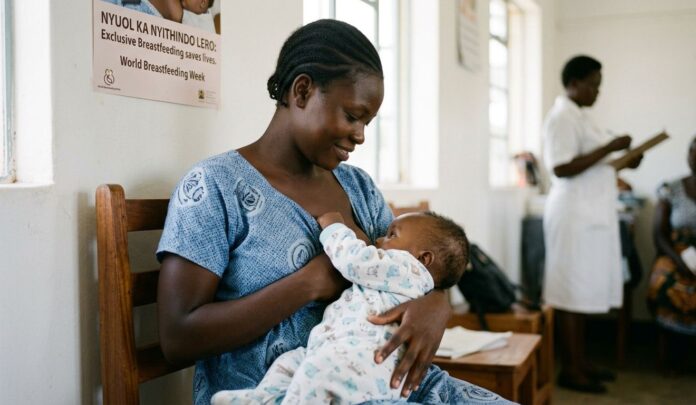
Homa Bay County is setting the pace nationwide, emerging as a leading model by recording the highest proportion of mothers who exclusively breastfeed their children for the crucial first six months of life.
The lakeside county has achieved an impressive 81.5 percent exclusive breastfeeding rate and a 75.5 percent early initiation rate within the critical first hour of birth.
This comes as a success story after decades of community sensitization, civic education, and numerous engagements with local communities at the village level.
Mercy Awino, 27, from Karachuonyo in Homa Bay County and a mother of three, shared with Kondele News the benefits she has seen with her three-year-old daughter.
“My first two children did not breastfeed exclusively for six months. It had some effects on them, leading to frequent ailments that saw me visit health facilities,” she recalls.
“This last–born, however, I met a Community Health Promoter (CHP), who took me through the benefits of exclusive breastfeeding for the first six months, and then continuing even after introducing other foods for two years.”
Overcoming societal hurdles
Amidst the success, however, other societal challenges such as poverty still hinder some mothers from achieving 100% exclusive breastfeeding in Homa Bay County.
Winnie Achieng, 33, a mother who stopped lactating early, explained the compounding domestic pressures that led to her milk supply drying up.
“I stopped lactating due to inadequate milk, which I think was brought on by stress from life challenges in my marriage,” Achieng revealed, adding, “On top of that, poor nutrition and a lack of enough food at home was another primary source of inadequate milk supply.”
Partners also report challenges tied to reproductive health timing and misconceptions. Gilbert Ochieng, Winnie’s spouse, narrated why his wife was forced to stop breastfeeding their infant prematurely.
“My wife conceived when our baby was only five months old,” Ochieng stated adding that, “The infant stopped breastfeeding, and her milk supply was very little.”
National progress and global context
The achievement in Homa Bay County also mirrors the strides made across Kenya, which currently stands at 60 percent, having climbed from 17 percent over the past two decades in 2003.
While global exclusive breastfeeding rates hover around 48 percent against a WHO target of 60 percent by 2030, Kenya presents a compelling success story in transforming its child nutrition landscape.
Health experts across the nation are emphasizing that breast milk remains the ultimate shield for infant survival and lifelong development.
According to data from the World Health Organization (WHO) and UNICEF, suboptimal breastfeeding practices take a devastating toll worldwide.
Globally, over 800,000 child lives could be saved every year if every infant were exclusively breastfed for the first six months and continued nursing alongside safe complementary foods up to two years of age.
Infants who are not breastfed at all face severe risks: they are up to 14 times more likely to die from infectious diseases such as pneumonia and severe diarrhea compared to those who are exclusively breastfed.
Furthermore, an estimated 77 million newborns globally (nearly one in two) are not put to the breast within the first hour of birth, increasing their mortality risk during the first month of life by up to 80 percent.
Beyond the direct loss of life, millions of children suffer long-term developmental setbacks, stunting, and cognitive deficits due to inadequate early nutrition.
The economic impact is equally severe, with global losses from suboptimal breastfeeding and related childhood illnesses exceeding $300 billion annually.
Debunking deeply ingrained myths
Nutritionists Linda Odhiambo and Vivian Andal highlight that statistical gains stem from continuous health education and the active debunking of deeply ingrained myths.
“Exclusive breastfeeding means giving a baby breast milk only, without adding any other food or water for the first six months,” explains nutritionist Linda Odhiambo.
“This gives the child a solid foundation for growth and strong immunity, protecting them from preventable illnesses like diarrhea and pneumonia and aiding rapid recovery when sick.”
Ms Andal also emphasizes the vital role of early initiation and the biological protection provided during the initial hours after delivery.
“During the first hours after birth, mothers produce colostrum, the thick, yellowish first milk,” says Andal adding that, “A common myth is that colostrum is dirty or spoiled, but in reality, it acts as the baby’s first vaccine, packed with essential antibodies to fight off deadly infections.”
Another persistent misconception addressed by Odhiambo and Andal is the belief that infants require extra water, tea, or porridge during hot weather or early growth spurts. Medical evidence confirms that breast milk is over 80 percent water and fully satisfies both thirst and hunger.
Understanding the biological mechanics of a feed is critical for complete infant nourishment.
Andal notes that breast milk consists of two distinct components during a feed: fore-milk comes at the start of a session, containing higher water content to quench thirst, while hind-milk follows toward the end, rich in essential fats, calories, and proteins needed for healthy weight gain.
To ensure infants receive both foremilk and hindmilk, Ms Odhiambo advises mothers to allow at least 20 minutes of continuous feeding on one breast before switching to the other, cautioning against rushing feeding sessions.
Proper latching technique also remains a vital focal point for healthcare providers guiding new mothers.