
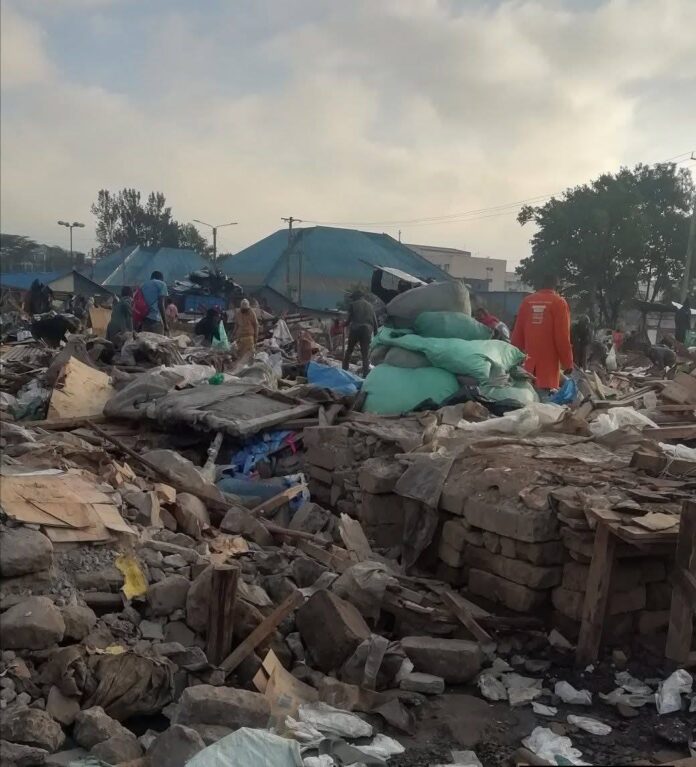
Traders at the Uhuru open-air market along Jogoo Road woke up to a scene of devastation after bulldozers moved in on Sunday night, March 8, 2026, to flatten their stalls.
This operation is part of a broader, aggressive campaign by both the Nairobi County Government and national agencies to reclaim road reserves across the city.
The demolition followed a tense week in which the Nairobi City County government issued a strict 72-hour ultimatum on Wednesday, March 4.
Despite the traders taking to the streets on Friday to protest the notice, blocking Jogoo Road and clashing with anti-riot police, the county followed through with the destruction under the cover of darkness.
Many traders, who rely on the market as their sole source of income, were seen on Monday morning sifting through the rubble to salvage whatever merchandise remained.
They continue to argue that they were never offered a viable alternative space to conduct their businesses.
This latest incident on Jogoo Road follows a series of high-profile “night-ops” by the Kenya National Highways Authority (KeNHA) along the Thika Superhighway:
Just days ago, KeNHA excavators flattened hundreds of kiosks and stalls at the Roysambu roundabout which was followed by a massive operation left over 1,000 traders counting losses, sparking violent protests that paralyzed the superhighway for hours.
KeNHA and the County government maintain that these clearances are necessary to construct designated bus bays and parking yards.
These facilities are intended to reduce the chaotic roadside pick-up and drop-off points that contribute to Nairobi’s chronic traffic congestion and rising pedestrian accidents.


