
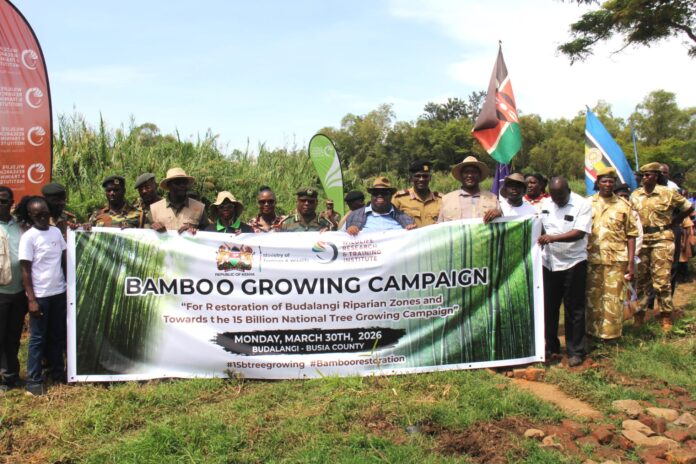
The government has stepped up efforts to restore riparian areas along the River Nzoia in Bunyala Sub-county, Busia County, as part of a broader strategy to curb persistent flooding and reduce human-wildlife conflict.
Speaking during the launch of a bamboo planting campaign in Budalang’i, Wildlife Conservation Secretary John Chumo said the initiative aims to rehabilitate degraded riverbanks and protect communities living in flood-prone areas.
Chumo noted that continued human activity within riparian and wetland zones has disrupted natural ecosystems, forcing wildlife, including crocodiles, hippos, and snakes, into human settlements.
“Encroachment of riparian land has led to the destruction of wildlife habitats, increasing cases of human-wildlife conflict. These animals now pose a direct threat to residents and their livelihoods,” he said.
He revealed that the government has spent approximately Sh1billion annually over the past three years to compensate victims of human-wildlife conflict, with Busia County receiving about Sh15million.
However, he emphasized the urgent need to shift focus toward preventive measures.
“In cases of loss of life, compensation cannot replace what has been lost. That is why we must invest in long-term solutions such as ecosystem restoration,” Chumo added.
He urged residents to embrace bamboo farming, noting the crop’s dual environmental and economic benefits.
The Power of Bamboo
Dr Patrick Omondi, Director of the Wildlife Research and Training Institute, confirmed that 10,000 bamboo seedlings have already been planted in partnership with local communities and community-based organizations.
“Scaling bamboo restoration in flood-prone areas like Budalang’i is not optional; it is essential,” Dr. Omondi said.
“Bamboo has a unique capacity to address multiple challenges at once. Its extensive root system firmly holds soil along riverbanks, significantly reducing erosion and preventing the collapse of river edges during heavy rains.”
Dr Omondi added that bamboo’s rapid growth makes it one of the most effective tools for land restoration, creating a protective buffer that slows floodwaters and restores habitats.
He also highlighted its role in climate change mitigation through high carbon sequestration.
Beyond conservation, the economic potential is significant.
“There is a growing market for bamboo products, including construction materials, furniture, and handicrafts. By integrating bamboo into agroforestry, communities can diversify their income while protecting the environment,” Omondi noted.
The Institute will soon deploy a team to conduct a formal assessment of human-wildlife coexistence in the area to guide future interventions and targeted mitigation measures.
National Goals and Local Safety
Busia County Commissioner Stephen Orinde noted that the initiative aligns with the national target of planting 15 billion trees by 2032.
“Busia County has a target of 7.5 million trees, and we have achieved 8.3 percent so far. Local administrators are working closely with communities to scale up these efforts,” Orinde said.
He added that bamboo planting complements existing infrastructure, such as dykes, which have already helped mitigate flooding in Budalang’i.
With the rainy season approaching, Orinde urged residents to remain vigilant and move from high-risk areas early to avoid disaster.
“It is always better to prevent disasters than to respond to them,” he said.
The project received a warm welcome from local stakeholders. Auma Makhulo, representing the Bunyala Catchment Area Water Resources Users Association, noted that the project enhances safety while creating a new economy.
“This initiative will protect our people from floods and provide income through the sale of seedlings. We encourage the expansion of this program so more residents can benefit,” Makhulo said.