
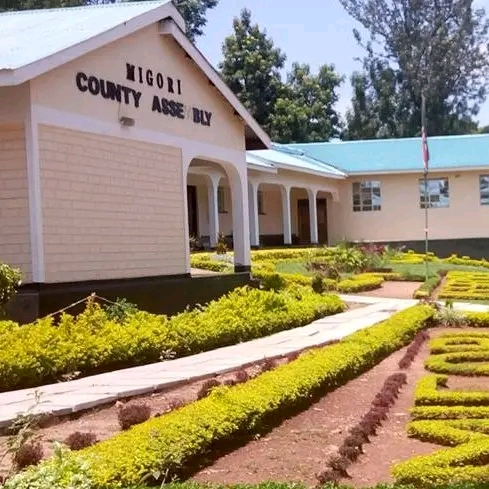
Moments after the Migori County Assembly passed the historic Sh12,422,885,162 budget estimates for the 2026/2027 financial year, a fierce battle of words erupted on the assembly steps.
While the executive now has the legal green light to spend, post-vote reactions from Members of the County Assembly (MCAs) reveal a house deeply divided over equity, unfulfilled promises, and the looming shadow of the 2027 general election.
The County Government of Migori finalized its budget estimates for the 2026/2027 financial year, balancing total estimated revenue and matching expenditure at an exact figure of Sh12,422,885,162.
A significant portion of this fiscal plan, amounting to Sh8,657,479,775 or 69.69 percent, is dedicated to recurrent expenditure to manage the county’s daily operational demands.
Within this recurrent segment, Sh4,479,968,997 is earmarked specifically to cover salaries and personnel costs, while Sh4,177,510,778 is reserved for ongoing operations and maintenance.
Conversely, the county has set aside Sh3,765,405,387, representing 30.31 percent of the total budget, to fund long-term development projects across its various sectors.
The funding for this budget is heavily anchored on the equitable share received from the National Government, which contributes the largest share at Sh9,164,503,127.
This national allocation is bolstered by Sh1,381,771,749 in international partner and donor funding, which includes major investments like Sh425.4 million for the Kenya Devolution Support Program II and Sh231.25 million for the National Agricultural Value Chain Development Project.
Own sourced revenue
Locally, Migori County projects to collect SH1,202,000,000 from internal own-source revenue, comprising Sh675,000,000 in ordinary local revenue and Sh520,000,000 via the Health Services Management Fund.
Additionally, the national government provides Sh674,610,286 in specialized conditional allocations, featuring Sh217,582,697 to transition Universal Health Coverage (UHC) workers into permanent roles and Sh144,621,807 to support local fertilizer subsidies.
Sectoral allocations reveal where the county is prioritizing its spending, with the Public Service Management, Monitoring and Evaluation sector receiving the largest single funding pool of Sh4,762,595,565, of which Sh4,000,000,000 is directly allocated for civil service basic salaries.
The County Executive is assigned Sh490,494,028, with SH245,000,000 dedicated strictly to the Office of the Governor. For the Agriculture, Livestock, Veterinary Services, and Fisheries sector, a total budget of Sh488,823,781 has been established, leaning heavily toward development investments at Sh443,187,331 to aggressively fund donor projects and crop development.
Other crucial sectors have been apportioned dedicated resources to ensure comprehensive service delivery, the Education, Gender Inclusivity, Social Services, Youth, and Sports sector is allocated SH188,345,016 overall to construct and improve early childhood education infrastructure, vocational training, and social programs.
To handle legal compliance and dispute resolution, the Office of the County Attorney is provided a recurrent operational allocation of Sh70,000,000.
The ICT, E-Governance & Innovation sector receives SH60,494,028 entirely for recurrent needs such as automation, network upkeep, and system repairs.
Finally, the Public Service Board is allocated SH56,576,920 for personnel planning and management services, while the offices of the County Secretary and the Deputy Governor are each assigned a flat package of SH40,000,000 for general administrative and support services.
Time constraints
Speaking immediately after the final gavel fell, Graham Kagali, MCA for South Kanyamkago and Chair of the Budget and Appropriations Committee, lauded his colleagues for fast-tracking the Appropriation Bill.
However, his tone quickly turned pragmatic as he looked ahead to the 2027 political calendar.
“We have done our part in the Assembly,” Kagali told the press adding that, “The executive must now fast-track the procurement process. We are entering an election year, and the public expects these promises to be delivered efficiently before political disruptions begin.”
While acknowledging that the Sh12.4 billion envelope still falls short of fully funding the county’s ambitious five-year County Integrated Development Plan (CIDP), Kagali offered a silver lining on the county’s historical debts.
“The reports tabled before this house show a positive trend,our pending bills are successfully dwindling.”
Tagare Member of County Assembly Moses Magwe echoed the sentiment that the executive has run out of track.
“The assembly has given them exactly what they asked for,” he noted.
“The county government no longer has any excuse for underperformance or failing to fulfill its manifesto.”
Coercion and bribery
The festive mood of the budget passage was sharply punctured by Chris Kwenya, an ODM Youth Representative, who delivered a blistering critique of both the budget’s contents and the legislative process itself.
“This is not a fair fiscal plan; it is a document of deep political partiality,” Kwenya alleged while outside the chambers.
Kwenya directly challenged Kagali’s optimistic view on debts, claiming that select contractors are receiving preferential treatment.
“Pending bills are only being cleared for contractors politically aligned with the executive. Meanwhile, legitimate local businesses have been left holding unpaid invoices stretching as far back as 2013!”
Kwenya further expressed deep disappointment on behalf of the county’s younger demographic, pointing out that critical youth affairs funding had been slashed.
Specifically, he pointed out the executive’s failure to allocate matching co-funding for the Youth Entrepreneurship Fund, a joint partnership with national frameworks.
However, there were Kwenya’s allegations regarding how the historic budget secured its passage.
He claimed that the vote was far from a democratic consensus, alleging that assembly members were subjected to intense intimidation, coercion, and bribery to force the estimates through without independent oversight.
Marginalized wards promise retaliation at the ballot
The regional cracks in Migori’s political landscape were also on full display during post-vote briefings.
Tagare MCA Moses Magwe expressed bitter frustration that despite the record-breaking budget size, critical flagship infrastructure commitments promised to their constituents have been completely sidelined.
“For four years, we have been promised the Getonganya project and it has failed to see the light of day,” he stated.
With this being the final full budget cycle before the electorate goes to the polls, the warning to the current county leadership was crystal clear.
“Constituents from marginalized regions are watching these unfulfilled promises very closely. We will remember this when we decide our next political moves in 2027.”