
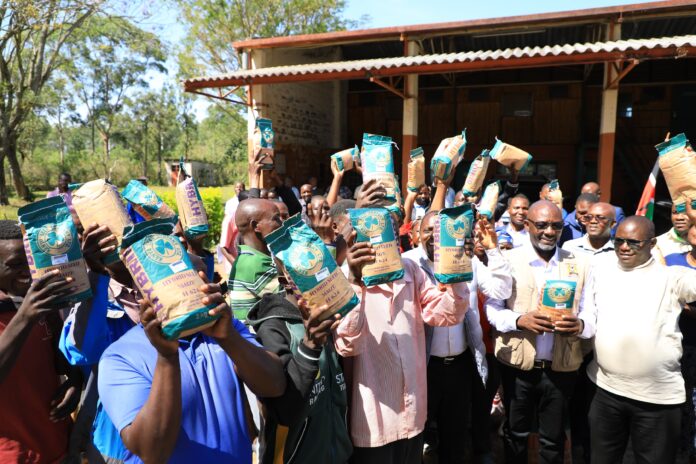
The Migori County Department of Agriculture has flagged off an extensive seed distribution program designed to boost food security and assist small-holder farmers ahead of the short rains season.
The initiative spearheaded by the county administration under Governor Ochilo Ayacko will see thousands of vulnerable households receive certified, high-yield seeds specifically selected to match the distinct micro-climates of their respective regions.
Speaking during the flag-off ceremony, Migori County Deputy Governor Joseph Mahiri, alongside the County Executive Committee (CEC) Member for Agriculture Lucas Musenda, emphasized that the distribution targets small-scale farmers who lack the financial capacity to purchase modern, certified seeds for the upcoming planting period.
“We are meeting here today with farmers and county officers to initiate the program of distributing maize seeds to farmers who are preparing to plant during this short rainy season running between August and September,” Mahiri stated.
“Across all our 40 wards, we are targeting over 5,000 small-scale farmers, with each receiving a 4-kilogram packet of certified seed to help them recover and boost production.”
Tailored seeds
Unlike generic relief distributions, county officials led by Musenda clarified that this exercise relies on ecological mapping to ensure farmers receive seed varieties suitable for their specific sub-counties.

Musenda noted that drier regions such as Nyatike require fast-maturing, drought-tolerant varieties due to shorter rainfall windows, whereas higher-altitude regions like Kuria and Rongo require different high-yield seed types.
In addition to maize, the county is prioritizing climate-resilient alternatives. In flood-prone and arid zones like Nyatike, local agricultural strategies are placing heavier investment and resources into commercial rice production to ensure sustainable food yields.
Bridging last season’s harvest deficit
The distribution comes as a direct response to significant crop losses experienced across the county during the previous farming cycle.
Agricultural records reveal that erratic weather patterns severely undercut region-wide production targets during the previous season. Despite aiming for a target production of 150,000 metric tons of maize, farmers realized an actual harvest of only about 127,000 metric tons.
This drop was largely driven by extreme weather shifts, ranging from intense flash floods that washed away crops in Kuria and Nyatike to subsequent prolonged dry spells.
As a result, the region closed the season facing a net deficit of approximately 23,000 metric tons.
To prevent further deficits, Agriculture boss Musenda and his team of agricultural officers are actively advising farmers to adhere to strict agronomic guidelines and land-preparation protocols.
With potential heavy rainfall and El Niño warnings on the horizon, authorities are pushing for timely planting to minimize potential crop damage and maximize output.
“I would like to inform our farmers that seeds alone will not solve the problem,you must also follow the instructions of our agricultural officers. We have been advised that there might be El Niño ahead, bringing heavy rainfall. Therefore, we must follow instructions and plant these crops properly to minimize potential damage,” Musenda advised.
While county officials acknowledged budget constraints in reaching every farmer in the county, they reaffirmed their commitment to expanding the Department of Agriculture’s allocation in subsequent budgets to scale the program further.