
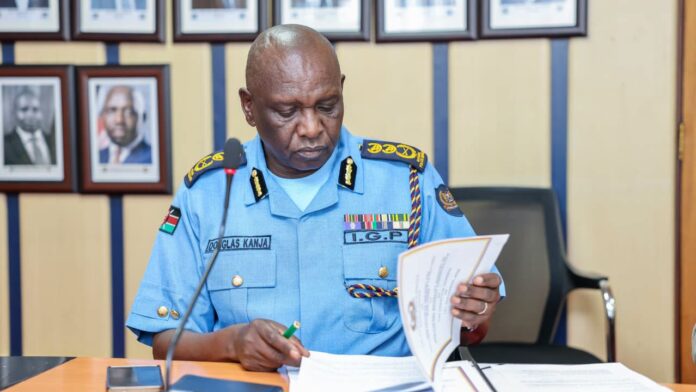
Inspector General of Police Douglas Kanja has been cited for contempt of court after police officers unlawfully erected barricades around Nairobi’s Central Business District (CBD) during the Gen Z protest commemorations on June 25, 2026.
Justice Patricia Nyaundi ruled on Thursday that Kanja is personally liable for defying a standing court order that required the National Police Service to issue prior public notices before setting up roadblocks or restricting traffic flow.
The judge ordered the Police Chief to personally appear in court on September 22, 2026, for mitigation ahead of his sentencing.
“I hereby direct Douglas Kanja to attend court on September 22, 2026,” Justice Nyaundi ruled, noting that the Inspector General failed to prove he took any concrete steps to enforce the court-ordered notification requirement.
The contempt application was filed by rights advocacy group Katiba Institute following widespread transport disruptions during the June 25, 2026 demonstrations, which marked the anniversary of the historic June 2024 Finance Bill protests.
The group submitted evidence showing that police mounted heavy roadblocks across key access points into the city without issuing any prior public alerts.
Affected areas included: Uhuru Highway, Ngong Road, Moi Avenue, and Parliament Road while other key intersections included City Mortuary Roundabout, Integrity Centre, Roysambu, Kangemi, Karen, Kitengela, Ruiru, and Githurai.
Katiba Institute argued that the unannounced barricades violated conservative orders issued in July 2025 by Justice Lawrence Mugambi, which strictly prohibited the police from arbitrary road closures without adequate public communication.
The rights body maintained that the police action crippled daily routines, blocking citizens from reaching workplaces, medical facilities, and essential services.
Police defense
In a replying affidavit filed on Kanja’s behalf, Nairobi Regional Police Commander Issa Mohammed Mohamud tried to push back against the contempt charge, arguing that: July 2025 order did not place an absolute ban on mounting traffic diversions, security checkpoints, or roadblocks, secondly the barricades put up on June 25 were operational split-second decisions rather than a centrally coordinated command strategy.
However, Justice Nyaundi rejected the defense, ruling that operational discretion does not override direct court directives designed to protect public rights and the rule of law.
With the court holding Kanja individually responsible for the breach, attention now shifts to the September 22 hearing.
The Inspector General will be given a chance to present his mitigation before the High Court hands down its sentence or fine.


