
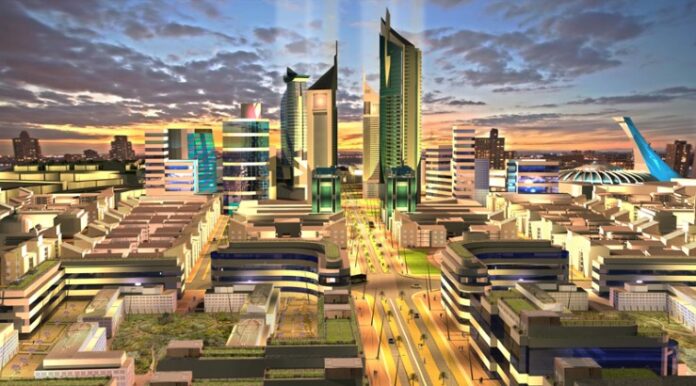
BY CYRUS MUNGUTI: In Machakos County, just 60 kilometres from Nairobi city, a new city is slowly rising from the red soil. The Konza Technopolis, commonly known as Konza City, was created to become Kenya’s modern technology city.
For years it lived theoretically mostly on paper and in government speeches.
Today,however, it is becoming something people can see work on and admire
The idea for Konza City was introduced as part of Kenya’s Vision 2030 development plan. The goal was simple but ambitious,build a place where technology companies, universities, research centers, and international businesses could thrive together.
Unlike older cities that grew without a plan, Konza is carefully designed from the ground up. It has wide smart roads, intelligent traffic systems, reliable fiber internet, and green spaces built into the master plan.
The city is expected to support thousands of jobs in information technology, engineering, health sciences, and education.
From dream to reality
Phase One is now complete, and that changes everything. Investors and students can finally walk through real buildings with real power and water, not just look at drawings. The foundation is set, and the city has a working skeleton.
One of the most visible signs of progress is East Africa’s first automatic underground waste collection system.
Instead of garbage trucks moving through neighborhoods every morning, waste moves through sealed underground pipes. The system can handle up to 40 tonnes of garbage every day.
That is a lot of waste, but the streets stay clean, quiet, and free of traffic from collection trucks; it also reduces pollution and makes the city healthier. Most cities add this kind of system decades after they are built. Konza planned it from day one.
Education is another big step forward. The Kenya Advanced Institute of Science and Technology, KAIUST, has been established inside Konza.
This will help students and researchers train in areas like artificial intelligence, biotechnology, and engineering.
The design is practical: students can learn in class and then walk straight to a research lab to test their ideas. Companies can partner with students and teachers to solve real problems.
That link between classroom and industry is how talent grows at home instead of leaving the country.
Employment opportunity
Jobs are following the infrastructure. The city is creating thousands of jobs in manufacturing, research, digital services, and export businesses.
That means opportunities are not limited to software developers. There will be work for engineers, lab technicians, factory workers, designers, and business managers.
This mix is important because a real city needs all kinds of skills to function.It will help keep Kenyan talent in the country and show that Africa can build world-class cities for the digital age.
Although the city is still developing, many people believe Konza City will one day become one of Africa’s leading smart cities.
Phase One proved it can be done. The next challenge is filling the city with people, ideas, and businesses. If that happens, Konza will do more than create opportunities for thousands of Kenyans.
It will prove that Africa can design and build world-class cities for the digital age and the better future of the country


