
When a baby arrives before it is fully ready, the happiness of birth can swiftly shift into an anxious struggle for survival.
Rather than leaving the hospital with their newborns, some parents end up in neonatal wards, watching over fragile infants linked to machines while doctors and nurses fight to keep them alive.
For babies born too soon, every hour counts. In hospitals where specialised neonatal tools are scarce, even skilled staff can struggle to give these newborns the care they need.
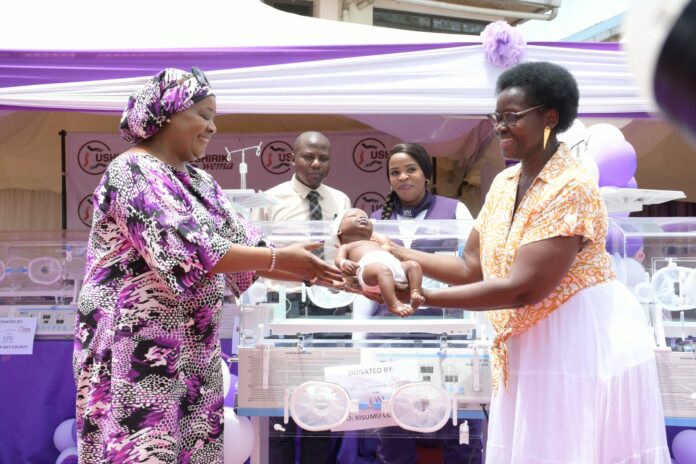
Against this reality, six counties in the Nyanza region are about to receive neonatal incubators through the ninth phase of the Okoa Malaika programme.
The initiative, run by the Ushiriki Wema Foundation, aims to improve care for premature and critically ill newborns.
The equipment was officially handed over on 29 September at Lumumba Sub-County Hospital in Kisumu.
The ceremony brought together Tessie Musalia Mudavadi, spouse of the Prime Cabinet Secretary, county health officials, representatives from the counties, healthcare workers and partners.
The counties set to benefit are Kisumu, Siaya, Homa Bay, Kisii, Nyamira and Migori. Reports from the event show that 11 incubators are being shared in this latest round.
The move comes as Kenya continues to confront preventable newborn deaths.
The Ministry of Health puts the newborn mortality rate at roughly 21 deaths for every 1,000 live births.
In response, the government is rolling out the Every Woman, Every Newborn, Everywhere (EWENE) Acceleration Plan for 2026–2028 to raise survival rates for mothers and babies.
A mother’s story
For Emma Awour, the birth of a premature baby meant stepping onto a path she never expected.
She is the mother of two children, both born early.
Her daughter arrived at 31 weeks and weighed just 1.3 kilograms. The baby remained in a neonatal intensive care unit for two months.
“It was hard,” Awour remembered, speaking of the sight of her newborn surrounded by tubes, doctors and nurses instead of being able to take her home.
As an occupational therapist herself, Awour took an active part in helping her daughter reach key developmental milestones.
The baby needed support to master basic skills such as breastfeeding, sitting up and gaining control of her head.
Seven years on, the girl is healthy and in Grade Two, her mother says.
Yet Awour’s experience with early births did not stop there. Her second preterm child was born at 28 weeks, weighing 1.5 kilograms, and spent a month in the neonatal intensive care unit. The boy is now two years old.
Awour gives credit to the doctors, nurses and other health workers who cared for both children and helped them through the most fragile early weeks.
Her story shows why access to neonatal equipment can make a decisive difference for families whose babies arrive before their bodies are prepared for life outside the womb.
Behind every incubator is a mother
At the handover, Jacky Waithaka, brand ambassador for Okoa Malaika, explained that the programme was created to build hospitals’ ability to look after premature babies.
Waithaka noted that the initiative has already reached 38 counties and stressed that the equipment is more than just machines.
“Behind every incubator,” she said, “is a mother waiting to hold her child, a family hoping for good news and healthcare workers doing everything possible to save a newborn.”
The programme runs under Ushiriki Wema, a non-profit organisation led by Tessie Mudavadi.
According to the organisation, Okoa Malaika concentrates on supplying essential neonatal tools such as incubators and incu-blankets, especially to rural and underserved facilities. It has previously delivered equipment to many hospitals across the country.
The gap after delivery
A health official representing Homa Bay County observed that Kenya has made gains in maternal care, yet still faces difficulties when mothers deliver premature or very low-birth-weight babies.
He argued that encouraging women to give birth in health facilities must be matched by the capacity to care for infants who need specialised attention.
The donated incubators, he said, would allow facilities in Homa Bay to offer more care closer to home and reduce the constant need for referrals.
Homa Bay is also improving the early identification of high-risk mothers from the start of pregnancy through Community Health Promoters, with the goal of spotting possible complications sooner. The county uses reviews of maternal and newborn deaths to pinpoint weaknesses in care and strengthen newborn services.
Migori’s referral load
In Migori County, the support is expected to reinforce newborn services at Migori County Referral Hospital, the main referral centre for the county.
Speaking on behalf of Governor Ochilo Ayacko, First Lady Agnes Ayacko explained that the hospital receives mothers and newborns referred from facilities across Migori and neighbouring counties. She added that the hospital also treats patients from Narok, Homa Bay and Kisii, and that its location near international borders means it can receive patients from across the region as well.
“Strengthening neonatal care at the hospital therefore has effects that stretch far beyond Migori town,” she said.
Agnes noted that county health teams regularly review maternal and perinatal deaths to identify where care can be improved. She said the donated equipment would help health workers looking after premature babies and close some of the gaps revealed by those reviews. She also stressed the need for the incubators to be properly installed, maintained and operated by trained staff.
From national policy to hospital wards
The handover coincides with Kenya’s implementation of the EWENE Acceleration Plan 2026–2028.
The plan was launched in May 2026 as part of national efforts to cut preventable deaths of mothers and newborns. Its goals cover antenatal care, skilled deliveries, postnatal care and access to emergency obstetric and newborn services.
The Ministry of Health has also reported roughly KSh 12.5 billion invested in maternal and newborn health measures, including funding for essential newborn care, supplies and the recruitment of nurses.
At the Kisumu event, Tessie Mudavadi said the incubators were meant to bridge the gap between the skills of health workers and the equipment they need to put those skills into practice. She observed that staff can possess the knowledge, ability and dedication to save a newborn yet still be limited when the necessary tools are missing.
For her, the incubators therefore stand for more than hospital hardware. They represent a real chance for premature babies to live.
Kisumu’s wider appeal
Kisumu First Lady Dorothy Nyong’o welcomed the donation and said the county was ready to partner with others to lower newborn deaths.
She referred to the national figure of 21 deaths per 1,000 live births and said Kisumu aimed to drive that number down even further.
Nyong’o also urged that maternal health services be used as an entry point to tackle other health issues facing families. She suggested incorporating screening for conditions such as breast and cervical cancer into women’s health programmes, while encouraging men to take up appropriate checks as they grow older. She further underlined the value of protecting girls from cervical cancer through HPV vaccination.
The foundation behind the work
The ceremony also drew attention to the long-standing role of the Mudavadi Memorial Foundation Trust Fund. A speaker at the event said the foundation was established in 1997 with four main focus areas: education, health, economic development and heritage.
Health has remained one of the channels through which the foundation and its partners work with communities. Okoa Malaika has grown into one of the initiatives dedicated specifically to premature and vulnerable newborns.
Its organisers emphasise that the aim is not merely to hand out equipment but to strengthen the capacity of health facilities and their staff to deliver proper neonatal care.
A struggle that continues beyond the incubator
For families such as Awour’s, an incubator is only one stage of a longer journey. A premature baby may need specialised medical care, constant monitoring, help with feeding and developmental support before it is ready to leave hospital.
Awour’s two children came through their early challenges, yet she still recalls the uncertainty that parents feel in neonatal units. Her experience also serves as a reminder that survival does not finish the moment a baby leaves the incubator.
Children born early may need ongoing support as they grow and develop. For the six counties receiving the equipment, the task now is to keep the incubators working and available to the babies who need them.
Mudavadi called on the counties and facilities to install, maintain and manage the machines properly so they can serve newborns for years to come.
The Ministry of Health’s current strategy for newborn survival likewise stresses stronger facilities, skilled health workers, effective referral systems and clear accountability. The central message from the Kisumu ceremony was therefore simple: equipment alone cannot save a premature baby.
It must be paired with trained staff, timely referrals, functioning hospitals and continued support for mothers and families.
For a mother standing beside a neonatal unit, waiting for her tiny baby to pull through, an incubator can still offer something precious: a real fighting chance.