
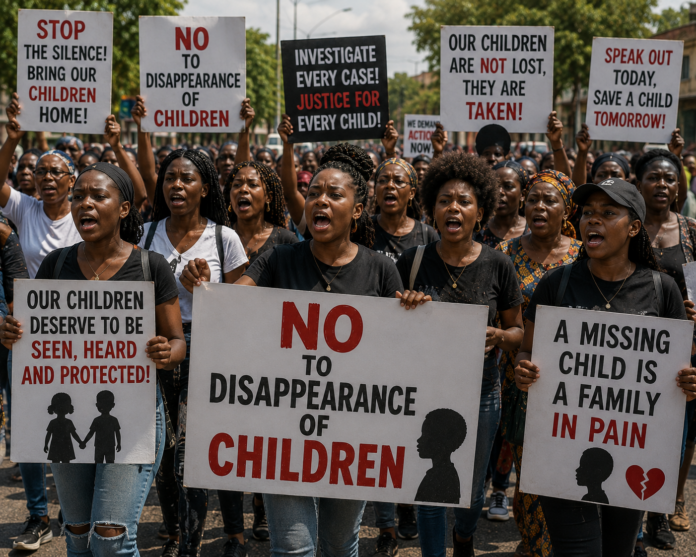
In Kenya, families in both urban and rural areas are enduring sleepless nights as children disappear one by one, not only in the dead of night but also in broad daylight.
Some are sent on everyday errands never to be seen again, while others vanish without explanation, leaving behind devastated families clutching photographs, unanswered questions, and fading hope.
An keen look into this crisis reveals a hidden, multi-million shilling criminal network operating silently across Western Kenya, feeding one of the country’s least talked about crimes against humanity which is child trafficking.
Data from the 2019 Kenya Population and Housing Census by the Kenya National Bureau of Statistics (KNBS) indicates that children below 18 years constitute more than half of Kenya’s population, estimated at about 25 million minors.
This demographic reality exposes a massive, vulnerable population to the risks of exploitation, trafficking, and abuse.
A recent government report shows that between January 2025 and March 2026, Kenya recorded 10,581 child protection cases linked to missing and vulnerable children.
This figure translates to nearly 6,500 cases annually, highlighting what authorities describe as a growing national crisis.
Data from the Child Protection Information Management System (CPIMS), under the Directorate of Children Services, indicates that the country recorded 6,820 cases of abandoned children, 1,952 abduction cases, 1,636 missing children, and 173 trafficking incidents during the period under review.
At least 2,328 children remain unaccounted for.
For the families left behind, these statistics represent far more than numbers-they represent children whose beds remain untouched, whose uniforms still hang behind doors, and whose parents continue searching endlessly for answers.
Border routes
In Western Kenya, particularly in counties bordering Uganda such as Busia, traffickers exploit porous border points, weak surveillance systems, and widespread poverty to move children across international boundaries undetected.
Data from National Crime Research Center studies paints a disturbing picture of rising offenses affecting vulnerable groups in Busia County, with defilement, Gender-Based Violence (GBV), and child abuse emerging as the most frequently reported cases in the border territory.
These high rates of defilement and GBV expose the acute vulnerability of women and children within Busia’s busy transit environment.
Child abuse cases also feature prominently, raising major alarms over the safety of minors in a region increasingly linked to cross-border criminal networks.
In a recent crackdown, 30 minors some as young as 14 years old, en route to Europe were rescued by security agencies after falling victim to false promises of “greener pastures” abroad.
According to Western Regional Police Commander Issa Mahmud, traffickers lure unsuspecting youth by offering free travel and high-paying jobs.
They are then smuggled through the porous Kenya-Uganda border points into Uganda, moved to Sudan, and eventually transported to Libya.
“Once they arrive in Libya, the traffickers, who operate in coordination with networks in Kenya and other countries, contact the victims’ parents and demand ransoms of up to Ksh 3 million to facilitate their journey across the Mediterranean Sea,” Mahmud explained.
Investigations reveal that traffickers systematically target vulnerable children from impoverished households, child-headed homes, and informal settlements.
Some are promised jobs, educational opportunities, or financial support, while others are lured with simple gifts, mobile phones, and false promises of a better life.
In 2025, Ugandan broadcaster NBS TV reported that 22 children aged between 4 and 17 were rescued during an interception conducted by authorities in Busia District on January 14, 2025.
The minors were intercepted in the custody of four traffickers, two Ugandans and two Kenyans.
A written inquiry sent to the regional authorities regarding the current fate and whereabouts of these children went unanswered.
A long-distance truck driver, who spoke on condition of anonymity, narrated how some minors are first introduced to commercial sexual exploitation before eventually being trafficked across borders.
“I have seen what happens. We have children who are groomed to work in brothels where truck drivers stop at night. We pay their bosses,” he revealed.
When asked to identify the exact locations of these brothels, the driver became hesitant and declined to provide directions, a clear reflection of the deep fear and secrecy surrounding the illegal trade.
Our investigations established that major transport corridors linking Kenya to Uganda through Busia are increasingly serving as active conduits for human trafficking operations.
During the launch of the Linda Mtoto Project, which is a child protection initiative implemented by the Free Pentecostal Churches of Kenya to prevent, identify, and respond to violations like Commercial Sexual Exploitation of Children (CSEC), the then Busia County Commissioner, Mwachaunga Chaunga, emphasized the urgent need to bring perpetrators to justice.
“Addressing these violations requires a multi-sectoral approach including the government, non-governmental organizations, parents, guardians, and citizens,” Chaunga stated adding that “Traffickers take advantage of porous borders, luring children into a world of false expectations and abuse. These heinous crimes not only shatter the lives of the victims but also tear at the fabric of society. We must work tirelessly to protect our children from such predators.”
Porous border, a catalyst of child trafficking
In an interview, Everline Achieng, a Project Coordinator for the Linda Mtoto Project in Busia, detailed how these uncontrolled pathways facilitate the movement of traffickers.
“Porous borders are completely unpoliced, and there is constant, free movement of people from one country to another. You realize that no one is doing proper checks to understand where these travelers are coming from, especially when it comes to the children being moved. Even if checks are carried out, they are not thorough,” Achieng said.
She added, “Furthermore, the close kinship ties between communities across the border allows free movement. Perpetrators easily use the excuse that they are simply going to visit relatives, making it incredibly difficult for law enforcement to tell if they are lying or telling the truth.”
Ms Achieng noted that poverty also plays a major role, particularly given currency differentials.
The perception that the Kenyan Shilling carries more purchasing power drives children to cross into Kenya, where perpetrators use them to generate income before pressuring their families to allow the children to be trafficked further.
Our findings show that minors are directly targeted both online through social media platforms and physically within their communities.
Traffickers systematically gain their trust through manipulation, gifts, and empty promises of employment or education.
Syndicate operators take advantage of high human traffic, informal crossing points, and corruption within border enforcement structures to move children unnoticed.
Once trapped, many children end up in forced domestic labor, commercial sexual exploitation, agricultural labor, street begging, or cheap labor markets.
While some girls are forced into prostitution in urban centers and border towns, boys are frequently used as underpaid or unpaid agricultural laborers and cattle herders, enduring harsh conditions without access to food, education, or freedom of movement.
Efforts to map out victims of trafficking yielded results last year after extensive referrals from various local sources.
In Matayos Constituency, we met Alexander (not his real name) alongside his family.
He narrated what transpired after he found himself held with eight other minors from different locations before being rescued by security agencies.
“They took me away without my consent, and I found myself in a poorly lit room where other children were being held. They gave us different clothes to change into, and then they handed us jembes (hoes) to start digging the land until 6:00 PM,” he recalled.
Alexander’s parents, speaking with visible remorse, described the restless night they endured after receiving news that their son had been abducted by unknown people in a car that sped off toward the Kenya-Uganda border.
“When he returned, I asked the child what happened. He said unknown people forcefully grabbed him and put him in a car after covering his eyes with a piece of cloth. He only realized they were in a bushy area within Busia when they arrived. They were given heavy tasks weeding a parcel of land before being taken to a building where they were being kept, awaiting trafficking to a foreign country. I think many kids have disappeared, even on their way from school; some are lied to with sweets. I am requesting law enforcers to increase surveillance and stamp out this trafficking,” his parent pleaded.
Ezekiel Wafula, a psychologist based in Busia, notes that many victims exhibit clear behavioral warning signs that communities frequently ignore.
“Do they appear frightened, confused, or withdrawn? Are they restricted from leaving premises freely? Are they working unusually long hours without breaks, or missing school? These are some of the warning signs the public should look out for,” Wafula explains.
Wafula added that prolonged exploitation leaves children with deep psychological trauma, depression, anxiety, and emotional withdrawal—effects that often persist long after they are rescued.
Poverty and being orphans
Experts identify systemic poverty as the primary driver of child trafficking in Kenya. Economic hardship leaves families unable to provide basic needs, making children easy targets for traffickers who disguise severe exploitation as a golden opportunity.
Research conducted in Mombasa among rescued victims established that a significant majority of trafficked children originated from Western Kenya, primarily girls aged between 13 and 17.
The study found that most victims came from economically disadvantaged households or child-headed homes.
Many had only attained a primary school education before being trafficked into domestic servitude, casual labor, or commercial sex work. Despite promises of fair wages and better lives, the children received nothing in return except physical abuse, psychological torture, and social isolation.
Researchers further established that while Western Kenya remains one of the major source regions, Mombasa serves as a key domestic destination point.
Alarmingly, approximately 32 percent of the trafficked children interviewed in the study originated from neighboring countries, including Uganda, Tanzania, Rwanda, and the Democratic Republic of Congo (DRC), demonstrating the deeply entrenched, cross-border nature of these syndicates.
Authorities and child protection agencies are also raising alarms over the growing use of social media by traffickers to recruit minors.
Social Media web
Children with access to smartphones are increasingly exposed to strangers offering fake jobs, scholarships, modeling opportunities, and romantic relationships online.
Experts warn that traffickers study vulnerable children carefully online before initiating communication and eventually isolating them from their families.
UNICEF and the Inter-Agency Coordination Group Against Trafficking (ICAT) estimate that children account for approximately 28 percent of identified trafficking victims globally, with Sub-Saharan Africa recording even higher proportions.
The agencies, however, believe the official statistics represent only a fraction of the actual numbers, as many victims never report the abuse due to fear, stigma, or a deep mistrust of authorities.
As cases continue to rise, the Kenyan government has intensified efforts to strengthen national child protection systems.
During the commemoration of International Missing Children’s Day, the Cabinet Secretary for Gender and Children Affairs, Hannah Wendot, directed that missing children cases must be reported immediately, abolishing the previous practice where families were told to wait 24 hours.
“Do not wait for 24 hours. Report to the police and to the Children’s Department immediately,” CS Cheptumo stated.
Principal Secretary for Children Services, Carren Ageng’o, revealed that Nairobi leads in reported missing children cases, followed by Nakuru, Kakamega, Homa Bay, and Kiambu counties.
Under a newly introduced multi-agency framework, all missing children cases must now be jointly reported to both police stations and Children’s Department offices to enhance rapid response and tracking.
Officials warn that failure by officers to act swiftly on reported cases will attract strict administrative accountability measures.
The government is also currently caring for over 44,000 children in state and charitable institutions whose parents or guardians remain unidentified, exposing the sheer scale of the crisis facing the country’s welfare systems.
Legal hurdles
Although Kenya enacted the landmark Counter-Trafficking in Persons Act in 2010, enforcement gaps continue to undermine successful prosecutions.
The law criminalizes sex and labor trafficking with stiff penalties ranging from 30 years’ imprisonment to life sentences.
However, experts argue that weak investigations, corruption, and poor data management continue to hinder convictions.
Government records indicate that in 2023, authorities investigated only 22 trafficking cases and secured just a handful of convictions, despite thousands of reported child exploitation incidents.
Analysts believe the absence of a centralized national trafficking database contributes to underreporting and poor coordination among enforcement agencies.
Civil society organizations also accuse certain rogue recruitment agencies and criminal networks of operating with political protection and exploiting weak oversight systems.
Ms Achieng (Linda Mtoto Project) also laments the weak cooperation between cross-border jurisdictions.
She points out that children rescued from traffickers are sometimes handed over to border authorities who, in turn, release them without proper safety protocols, making the trafficking loops incredibly difficult to track and shut down.
Family and community ignorance
Many local families still do not fully understand child protection policies or official referral pathways, and often do not know where to report violations.
Some lack faith in existing legal structures.
Furthermore, deep-seated cultural and economic pressures mean some guardians believe children must work to support the family, leading them to tolerate child labor or early marriages to benefit from bride prices.
Child rights organizations insist that ending trafficking will require stronger community vigilance and collective responsibility.
Parents are being urged to closely monitor their children’s movements, online activities, and interactions with strangers, while local administrators are being called upon to report suspicious activities involving minors.
Authorities emphasize that the first 24 to 48 hours after a child disappears are critical to increasing the chances of rescue and successful reunification.
Civil society groups continue to support rescue operations, rehabilitation, and the reintegration of trafficked children.
Through community radio talk shows and targeted awareness campaigns, they aim to equip families with the knowledge to recognize violations, including child trafficking, neglect, and illegal child labor, and understand the laws that protect minors.
Behind every trafficking statistic is a stolen childhood. From the dusty villages of Western Kenya to the busy border crossings of Busia and the brothels hidden along transport corridors, an underground network continues to prey on the vulnerability of the young.
As traffickers exploit poverty, broken enforcement systems, and porous borders, families continue to search for sons and daughters who vanished without a trace.
Unless stronger legal enforcement, community vigilance, and coordinated regional actions are implemented, more children risk disappearing into a criminal system that thrives on silence, fear, and human exploitation.
To build a permanent shield around minors, it is vital for both national and county governments to partner with local administrators to implement economic empowerment programs for vulnerable families.
When households are financially stable, they are far less likely to fall prey to the economic traps of child labor and trafficking syndicates.
Initiatives like the Child Rights Clubs pioneered in schools by the Linda Mtoto Project have already proven highly beneficial.
They equip children to know their basic rights and identify the exact referral pathways to report suspicious elements in their localities, proving that protecting Kenya’s children starts with giving them the voice and knowledge to fight back.