
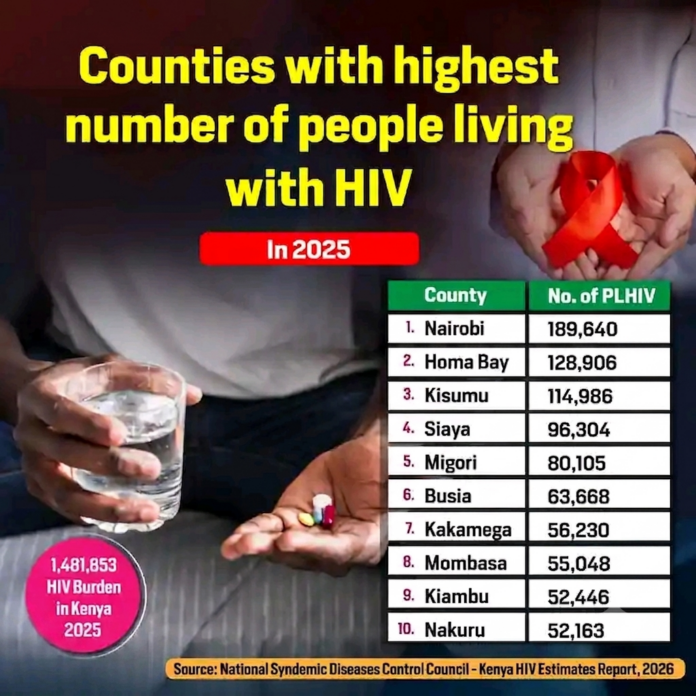
Freshly published epidemiological data from the National Syndemic Diseases Control Council (NSDCC) reveals a highly concentrated epidemic that heavily impacts specific geographic regions across Kenya, though longitudinal tracking demonstrates a steadily changing public health landscape.
While the cumulative nationwide HIV burden stands at 1,481,853 people living with HIV (PLHIV) in the latest tracking cycle, a comparison to the 1,326,336 individuals recorded in the previous year reveals a net increase in the total number of people living with the virus.
Public health experts note that this rise in absolute numbers actually reflects a positive trend of improved survival and longevity among patients due to expanded access to life-saving antiretroviral therapy (ART).
Geographically, the distribution of the disease remains starkly uneven across Kenya’s 47 counties.
Nairobi County holds the highest overall burden in the nation, accounting for 189,640 PLHIV, a reflection of its high population density, urban sprawl, and status as the capital city.
Lake region statistics
Following the capital, the epidemic remains heavily clustered within the Lake Region, where high-burden counties form a significant demographic pocket. Specifically, Homa Bay records 128,906 individuals living with HIV, Kisumu stands at 114,986, Siaya reports 96,304, and Migori accounts for 80,105 cases.
These statistics underscore how economic hubs, cultural practices, and regional dynamics shape the contours of the health crisis.
Transit corridors and secondary urban centers, including Busia, Kakamega, Mombasa, Kiambu, and Nakuru, round out the top ten most heavily impacted regions.
To understand the deeper structural shifts of this health crisis, the geographic data must be evaluated alongside broader demographic and epidemiological metrics tracked by national health agencies.
Nationally, the overall HIV prevalence rate experienced a slight upward shift from 3.03 percent in the previous cycle to 3.22 percent in the latest figures.
Gender imbalance
The burden of the disease continues to carry a significant gender imbalance; the female prevalence rate climbed from 4.0 percent to 4.3 percent in the latest report, while male prevalence held steady at 2.0 percent across both tracking periods.
Furthermore, tucked beneath the macro-level county rankings is a vulnerable pediatric population that has grown slightly from 62,798 children living with the virus to 69,330 children aged between 0 and 14 years nationwide in the current period.
On the prevention front, comparing recent annual cycles highlights major gains in curbing the spread of the virus.
Total new annual HIV infections saw a substantial decline, dropping from 19,991 cases down to 13,936 cases in the latest report.
Previously, a massive 60 percent of those new infections were concentrated in just ten counties, led by Nairobi with 3,045 new transmissions, followed by Migori with 1,572 and Kisumu with 1,341.
In the current infection cycle, the demographic distribution shows that adults make up the vast majority of new cases at 76 percent, while children account for the remaining 24 percent.
On the structural frontline of managing the disease, mortality trends offer a look at both the challenges and the historic achievements of Kenya’s healthcare system.
Annual AIDS-related deaths dropped from 21,007 down to 19,434 in the subsequent tracking year.
Within the current mortality figures, adults make up 88 percent of the fatalities, and children under fourteen make up 12 percent.
Despite the weight of these ongoing losses, the historical context provided by the NSDCC illustrates a major public health victory, as overall AIDS-related mortality in Kenya has dropped significantly over the last decade due to aggressive health policies and localized testing strategies.
Moving forward, public health officials emphasize that mapping these specific fluctuations across counties remains critical for targeted intervention.
By benchmarking current numbers against previous baselines, county governments and medical workers can properly allocate diagnostic resources, launch focused community awareness drives, and introduce advanced preventative medical measures directly to the communities that need them most.