
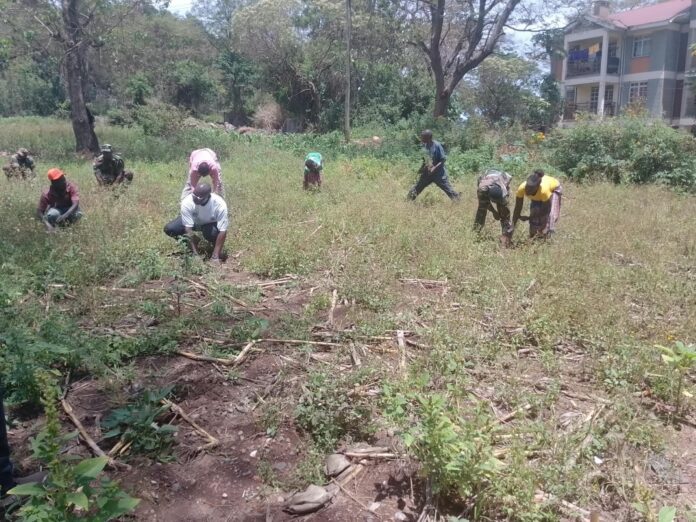
As Kenya prepares to celebrate Mazingira Day tomorrow, October 10, officials from the State Department for Mining and Kenya Forest Service have intensified awareness campaigns in Migori County.
The initiative aims to address the double threat of widespread land degradation from mining activities and the county’s low forest cover.
Speaking during an ongoing tree-planting drive at Ombo Forest, Tracy King’e from the State Department for Mining called on local artisanal miners to actively take part in environmental conservation and land rehabilitation.
“This activity is a preamble towards the build-up of Mazingira Day this Saturday on the 10th. We urge all people to participate, whether from your individual homes or with your institutions. Just come out in large numbers let’s save our environment,” Ms King’e stated.
She emphasized that the Department’s central focus for Mazingira Day is the restoration and protection of abandoned mining sites under the theme ‘Mine-Site Restoration to make degraded mining sites a safe space for all.’
To support the initiative, the Department is holding community awareness meetings (barazas) across local mining hubs to educate artisanal and small-scale miners on landscape restoration.
Mining threats and environmental hazards
The call for urgent intervention comes as continuous small-scale and artisanal gold, copper, and zinc mining across Migori leaves behind severe environmental scars.
Unregulated open pits, trenches, and deep excavation sites left by miners pose persistent physical hazards to residents and livestock.
During rainy seasons, these pits collect rainwater and spark flash floods, washing toxic chemicals such as mercury used in mineral processing into surrounding lands and water supplies.
By targeting active and abandoned mining sites for tree planting, environmental officers hope to stabilize open soil, prevent chemical runoff, and reduce physical hazards.
Migori County continues to grapple with low tree canopy coverage. Migori County Forest Officer Mbori John highlighted that forest cover in the area previously hovered between 0.3% and 0.9% before slowly rising to its current level of around 2%—a figure still far below the internationally recommended minimum standard of 10%.
To bridge the gap, forest and mining departments are executing a week-long tree-growing campaign.
“We plan to plant about 4,000 tree seedlings that will cover about 4 hectares. As we stand, we have just done 2,400, which is approximately two hectares, and the planting shall continue,” Mbori explained.
Looking ahead to tomorrow’s main Mazingira Day celebrations, forest teams, community groups, and local institutions aim to plant trees on at least 10 hectares of the 116-hectare gazetted Otacho Forest in Awendo Sub-County to boost local climate resilience.
The local tree-planting efforts in Migori directly feed into Kenya’s national agenda to grow 15 billion trees by the year 2032.
Led by the national government, the 10-year greening initiative seeks to restore millions of hectares of degraded landscapes across all 47 counties, lift national tree cover above 30percent, and mitigate climate change.
Officials have urged citizens nationwide to view environmental stewardship as a daily responsibility, using Mazingira Day as a springboard for continuous tree planting and landscape restoration in schools, institutions, farms, and degraded mineral zones.