
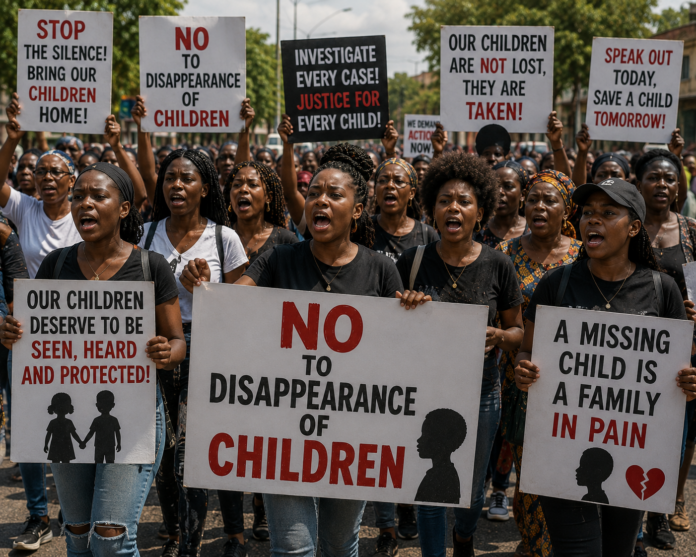
By FLEVIAN GEOFFREY: Kenya is grappling with a crisis, marked by a dramatic and frightening surge in child disappearances, abductions, and murders that authorities warn has escalated into a national emergency.
Data released by the Ministry of Gender and Children Affairs reveals that an average of 23 children vanish across the republic every single day.
Over recent weeks, the digital timelines of Kenyan citizens have been saturated with a continuous stream of frantic “MISSING” posters, forming a devastating mosaic of families living in a permanent state of terror.
Minors are increasingly disappearing from their routine environments, school routes, playgrounds, residential estates, and family doorsteps, leaving entire communities struggling for answers.
National emergency
The widening crisis found its latest tragic flashpoint in Njoro Sub-County, Nakuru County, following the painful murder of Mercy Nyambura, a 12-year-old Grade Six pupil.
Nyambura went missing while returning home in the evening, triggering search by relatives and neighbors.
Days later, her body was discovered dumped in a local maize plantation.
A subsequent post-mortem examination conducted at the Egerton University Mortuary confirmed she had been defiled and strangled to death, suffering multiple severe neck injuries.
A 16-year-old suspect has since been apprehended by detectives from the Directorate of Criminal Investigations (DCI) after allegedly confessing to the murder.
NATIONAL CHILD EMERGENCY MAP
[January 2025 – March 2026]
   │
   ├─► 10,581 Total Child Protection Cases Registered
   │     ├─► 6,820 Cases of Abandonment
   │     ├─► 1,952 Documented Abductions
   │     ├─► 1,636 Missing / Lost-and-Found Incidents
   │     └─►   173 Human Trafficking Cases
   │
   └─► 2,328 Children Remain Entirely Unaccounted For (22%)
Human rights groups and child welfare advocates emphasize that Nyambura’s death is not an isolated local tragedy, but the harrowing face of a wider systemic failure threatening the foundational fabric of Kenyan society.
The sheer volume of disappearances has forced state agencies and civil society to sound an unprecedented alarm.
Official metrics drawn from the Child Protection Information Management System (CPIMS) paint a stark picture of the pressures facing families.
According to a formal brief issued in Nairobi by the Cabinet Secretary for Gender and Children Affairs, Hannah Cheptumo Wendot, a staggering 10,581 child protection cases were officially logged over a recent 15-month window.
While child services statistics note that approximately 78 percent of registered lost-and-found cases are eventually resolved via active rescue or family reunification, roughly 22 percent, representing over 2,300 children, remain entirely unaccounted for.
Law enforcement sources acknowledge their fates hang in a terrifying void, caught between kidnapping syndicates, underground child trafficking rings, ritual-related violence, and extreme labor exploitation.
In direct response to the escalating numbers, the government has enacted immediate emergency measures, completely dismantling a long-standing police protocol that required families to wait 24 hours before filing a formal missing child report.
“We have said, do not wait for 24 hours. Report to the police and to the Children’s Department, whichever comes first,” Cabinet Secretary Cheptumo directed, confirming that law enforcement desks nationwide must now activate immediate multi-agency tracking operations.
The policy shift acknowledges that the first 48 hours are absolutely critical to a minor’s survival.
The failure of the “village”
Sociologists and community leaders point out that the spike in abductions exposes a fundamental breakdown in traditional social safety nets.
The historical communal fabric, long encapsulated by the African proverb that it takes a village to raise a child, has been severely hollowed out by sharp economic hardships, rapid urbanization, and community fragmentation.
In many urban and informal settlements, collective vigilance has gradually been replaced by public indifference. Neighbors no longer routinely watch over one another’s children, creating quiet structural vacuums that predators exploit with ease.
Furthermore, when disappearances do occur, institutional responses are frequently plagued by operational delays, underfunded local police posts, and poor forensic investigative capabilities.
Critics note a painfully predictable cycle has emerged: a child vanishes, local panic ensues, a digital campaign trends prominently across social media for several days, and if the victim is recovered dead, a brief wave of performative public outrage follows before collective consciousness shifts to the next news cycle.
The crisis of missing children directly intersects with broader patterns of gender-based violence and institutional negligence across Kenya.
Legal professionals and human rights organizations, including the Law Society of Kenya (LSK), note that just as the country has struggled to decisively curb an ongoing epidemic of femicide, highlighted by high-profile killings of ordinary citizens and international athletes alike, it is similarly failing to secure the baseline environments where children live, play, and learn.
Former LSK President Faith Odhiambo and current President Charles Kanjama have both publicly raised alarms, reminding the state that Article 53 of the Constitution guarantees every child absolute protection from abuse, violence, trafficking, and exploitation.
Mr Kanjama described the situation as a “grave national protection failure that can no longer be treated with routine statements or institutional silence.”
Exacerbating the crisis is a creeping online and offline culture of apathy and secondary victimization.
In multiple instances involving missing teenagers, public discourse frequently shifts away from the perpetrators to interrogate the victim’s socio-economic background, parental supervision, or personal lifestyle choices, diminishing structural accountability.
State officials, led by Government Spokesperson Isaac Mwaura, continue to urge parents to heighten household vigilance, advising them to sensitize children against accepting rides or gifts from strangers.
However, civil society maintains that the crisis cannot be resolved by shifting the burden of protection entirely onto families, nor by lighting candles after a child’s body is recovered from a plantation.
The tide of vanishing innocence will only turn when child safety ceases to be a rhetorical talking point for political podiums and becomes a non-negotiable budget and security priority enforced in every neighborhood and police station across Kenya.
Until that structural shift materializes, the headlines will continue to multiply, and the nation will continue to watch its future slip away in silence.
Members of the public are urged to report any suspicious activities or incidents regarding missing minors immediately to the nearest authorities or via the toll-free National Child Helpline 116.
Mshukiwa wa mauaji ya mwanafunzi Nakuru akiri kosa, akamatwaThis broadcast details the immediate local news coverage and police response following the apprehension of the suspect in the Mercy Nyambura homicide case in Nakuru County.