
BY JOYCE MWANGI: The escalating national standoff over a proposed U.S. Ebola quarantine center in Kenya has officially reached the highest office in the land.
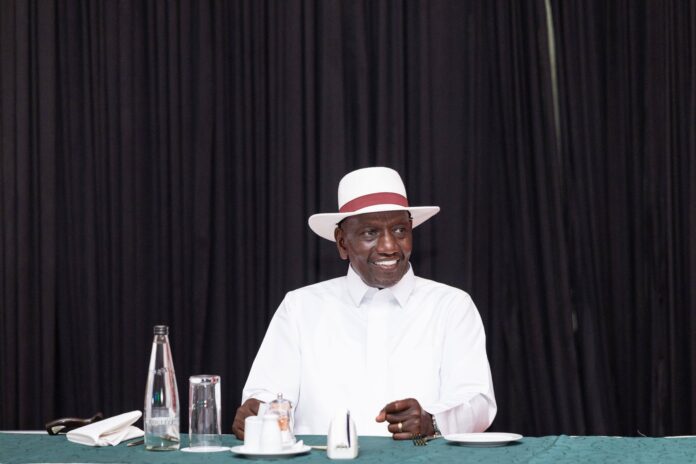
President William Ruto broke his silence on the controversial bilateral agreement, defending the project during a media round table in Wajir.
Despite a sweeping High Court freeze and volatile street protests, Ruto confirmed he personally authorized the facility at Laikipia Air Base following a direct request from U.S. President Donald Trump, framing the partnership as a standard continuation of Kenya’s long-standing strategic alliance with Washington.
The President’s public defense comes at a highly critical moment, arriving just hours after police in Nanyuki used tear gas to disperse hundreds of local residents protesting outside the air base.
Local communities have expressed deep anxiety over the possibility of accidental transmission, questioning why Kenya should bear the biological burden of isolating foreign citizens exposed to a lethal pathogen.
President Ruto, however, rejected claims that the center represents an unusual risk, likening it to the dedicated isolation spaces established at the Nairobi Hospital during the COVID-19 pandemic.
He emphasized that the decades-long partnership with the U.S. has historically brought immense resources to Kenya to combat major health challenges like HIV/AIDS and COVID-19, adding that institutions like KEMRI are central to this collaborative medical research.
Executive vs judiciary
This executive pushback directly challenges a major legal roadblock erected by the judiciary.
The High Court in Nairobi issued strict conservatory orders temporarily halting the entire project.
In a petition certified as urgent, the Katiba Institute, alongside the Law Society of Kenya, challenged the legality of the deal, arguing that the secretive, unilateral agreement lacked public participation and parliamentary oversight.
The court’s sweeping order explicitly prohibits the Kenyan government from admitting, receiving, or facilitating the entry of any foreign national exposed to the virus under this arrangement, forcing a tight 48-hour window for the state to file its formal legal responses.
At the heart of the standoff is a $13.5 million diplomatic package committed by the United States to bolster Kenya’s broader Ebola preparedness infrastructure.
While U.S. and Kenyan health officials maintain that keeping exposed, asymptomatic individuals close to the Central African outbreak zone reduces global transmission risks associated with long-distance travel, domestic critics remain unmoved.
Medical unions, including the Kenya Medical Practitioners, Pharmacists and Dentists Union, have threatened strike action, demanding full transparency.
They argue that because the rarer Bundibugyo strain currently has no approved vaccine, externalizing infectious disease risks to a country with zero confirmed cases is an unacceptable gamble.