
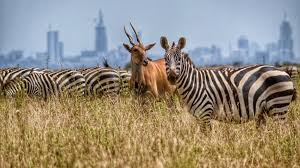
By MARY NDIRITU: Concerns are mounting over the long-term future of the Nairobi National Park as intensifying debates over urban expansion, infrastructure development, and land use deepen tensions between political leaders and conservationists.
The park, uniquely situated on the edge of Kenya’s capital city, has increasingly become a focal point of public discourse.
Rapidly rising urban populations and aggressive development projects continue to exert unprecedented pressure on its natural boundaries.
Conservationists warn that gradual encroachment and infrastructure expansion risk severing vital wildlife movement corridors, permanently weakening one of the country’s most iconic protected areas.
Lobby Groups
In recent weeks, environmental groups have raised the alarm over ongoing developments near the park’s buffer zones.
They argue that restricted corridors are already disrupting the traditional migration patterns of animals such as zebras, giraffes, and antelopes.
Additionally, rising noise, light pollution, and traffic from the surrounding metropolis are emerging as severe threats to the fragile ecosystem.
“We are seeing a park that is slowly being squeezed by the city,” said one conservation advocate.
“If urban planning is not strictly managed, the critical balance between development and wildlife conservation will collapse entirely.”
The debate has also taken on a political tone, with leaders and stakeholders sharply divided over how to balance national development priorities with ecological protection.
While some government officials defend transport and housing projects as necessary drivers for economic growth, critics argue that a lack of robust environmental consultation risks causing irreversible ecological damage.
Tourism sector threats
Tourism stakeholders are equally concerned, warning that any degradation of the park’s ecosystem could tarnish Kenya’s global conservation reputation and dent tourism revenue.
As a rare, world-renowned wildlife reserve bordering a capital city, the park’s preservation holds immense symbolic and economic weight.
Kenya Wildlife Service (KWS), on the other hand, have emphasized their ongoing monitoring and enforcement measures aimed at curbing illegal activities and mitigating human-wildlife conflict.
They, nevertheless, acknowledge that unrelenting urban pressure presents novel challenges that demand coordinated planning well beyond the park’s fenced boundaries.
The consequences of this shrinking buffer zone are already being felt by local communities.
Residents living near the park report frequent wildlife sightings in nearby settlements, particularly during dry seasons, raising public safety concerns and underscoring the friction between human habitation and wildlife territory.
As the debate intensifies, environmental experts and town planners are calling for a comprehensive, integrated land-use policy that seamlessly merges conservation with urban planning.
Without decisive, immediate action, they warn, Nairobi National Park faces gradual, irreversible ecological stress.
For now, the park remains both a priceless national treasure and a political fault line, perfectly embodying the wider struggle between economic progress and environmental preservation in a rapidly growing capital.