
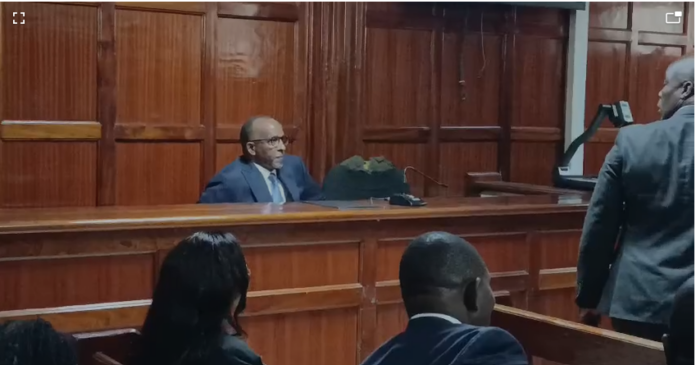
Health Cabinet Secretary Aden Duale has survived a 15month jail term after the High Court rejected persistent bids by civil society groups to send him to prison for contempt of court.
The case, which centered on a highly controversial, US-funded Ebola quarantine and isolation facility in Nanyuki, Laikipia County, concluded on Tuesday with High Court Judge Patricia Nyaundi opting to discharge the minister with a stern warning rather than a custodial sentence.
The legal battle stems from a bitter dispute over the construction and operation of the specialized medical facility.
The Katiba Institute and the Law Society of Kenya (LSK) had successfully secured conservatory orders from the court to freeze implementation of the multi-million shilling project.
However, the petitioners later returned to court with evidence proving that activities at the site had continued in direct defiance of the judicial freeze.
Contempt of court
Confronted with a formal finding of contempt, the petitioners’ legal teams aggressively pushed for the maximum possible penalty.
Counsel Malidzo Nyawa, representing the Katiba Institute, explicitly asked the court to sentence Duale to 15 months in civil jail, arguing that the case was a litmus test for institutional integrity.
Nyawa insisted that punishing senior public officials for contempt is vital to protecting public confidence in the justice system and preventing a lawless culture where judicial edicts are treated as optional suggestions.
In his mitigation, Duale fought to clear his name, presenting himself not as a defiant state officer but as a public servant navigating a public health landscape based on scientific and technical advice.
He tendered a formal apology to the bench and categorically maintained that neither he nor the Ministry of Health ever harbored any intention to disregard, undermine, or act in defiance of the honorable court’s directives.
Apology
This swift, submissive turnaround ultimately saved the Cabinet Secretary from a prison cell.
In her sentencing ruling, Judge Nyaundi observed that Duale’s prompt compliance with court summonses and his personal appearance during the mitigation phase carried significant weight.
“I have noted that Mr Duale has indeed submitted himself to the authorities of this court,” Judge Nyaundi remarked.
“Since this is the first instance the minister is responding to this, I will give him the benefit of the doubt… For that reason, I will accept the apology that has been sent.”
While the ruling provided massive political relief for Duale, the bench drew a hard line against state impunity.
Judge Nyaundi closed the session by emphasizing that her leniency must never be misinterpreted as tolerance for the disobedience of court orders, issuing a final, sharp caution to the Health Secretary against any future administrative missteps that could undermine the constitutional authority of the judiciary.


