
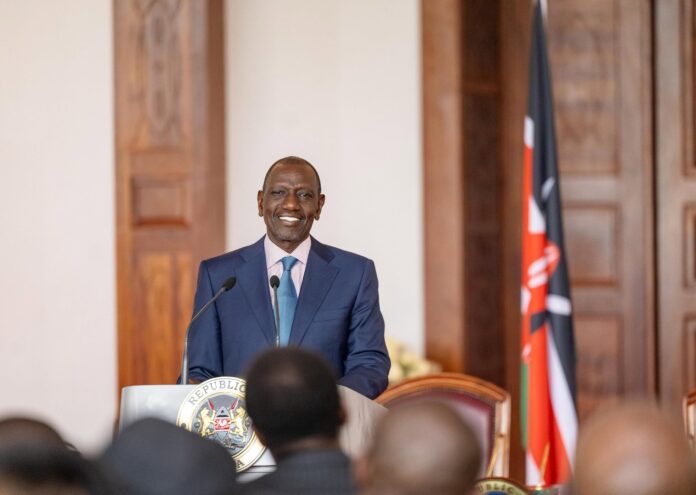
President William Ruto has pushed back against a wave of public anxiety over the newly enacted fiscal policy, dismissing claims that the Finance Act 2026 introduces aggressive new taxes on ordinary citizens.
Speaking at State House, Nairobi, on Tuesday after officially signing the contentious legislation into law, the Head of State blamed an influx of propaganda and digital misinformation for distorting the public’s understanding of the government’s economic agenda.
The President took time to systematically dismantle specific rumors that had fueled weeks of intense public debate and anxiety across the country.
He categorically denied that the new law imposes levies on mobile money transfers, second-hand clothing (popularly known as mitumba), water, or freehold land ownership. He reassured users of digital services that the cost of communicating and doing business would remain unchanged.
“There is no new tax on M-Pesa or mobile money,” President Ruto clarified.
“The money you send to your family, your business or your friends will move tomorrow as it has always done. We are pursuing tax avoidance, not taxpayers; offshore schemes, not ordinary wages; and leakages, not livelihoods.”
Rather than squeezing ordinary Kenyans, the President maintained that the primary objective of the Finance Act 2026 is to build equity into the national tax architecture.
The law, he argued, shifts the state’s focus toward closing historical loopholes, preventing offshore tax evasion, and enhancing compliance so that wealthy individuals and corporations meet their legal obligations.
He also defended the legitimacy of the process, noting that Parliament had subjected the initial bill to an extensive public participation exercise, drawing feedback from over 170 organizations and more than 100,000 individual citizens before finalizing the text.
Beyond tax enforcement, the newly minted law introduces a series of strategic economic buffers and green energy incentives.
To protect the local agricultural sector, the Act slashes the competitiveness of foreign imports by aggressively raising the duty on imported sugar from Sh7.50 to Sh40 per kilogram, a move the state estimates will shield 17 local sugar factories and safeguard the livelihoods of two million farmers.
On the innovation front, the law extends tax exemptions and incentives to electric buses, motorcycles, bicycles, solar batteries, and locally assembled mobile phones.
In a major relief measure for struggling businesses, Ruto announced a six-month tax amnesty that completely waives accrued penalties and interest on outstanding tax debts, giving taxpayers a clean window to regularize their financial affairs.
Furthermore, the Act expands access to affordable housing benefits by extending mortgage tax reliefs—previously exclusive to commercial bank borrowers, to individuals financing homes through registered microfinance institutions.
Combined with the signing of the Appropriation Act 2026, the President concluded that the country now possesses a robust, fully funded legal framework required to drive his administration’s Bottom-Up Economic Transformation Agenda.


