
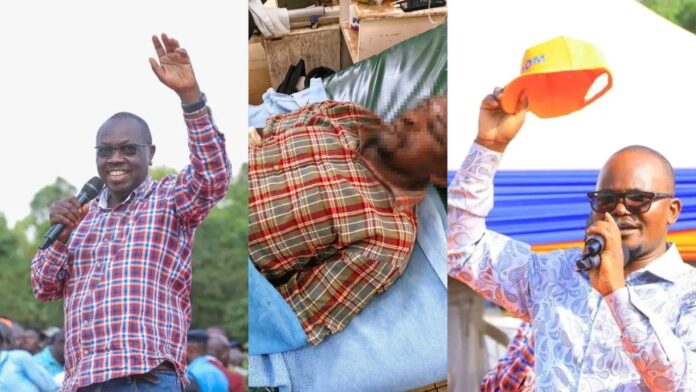
What was meant to be a financial lifeline for hundreds of struggling motorcycle taxi operators in Rongo Constituency has instead exposed the ugly, violent underbelly of local politics.
As the country inches closer to the high-stakes 2027 general election, a weekend empowerment fundraiser has left one man nursing severe machete wounds and laid bare a deeply entrenched culture of political goonism that threatens to turn this sub-county into a volatile electoral battleground.
The casualty of this brewing proxy war is Tobias Ochieng, a local resident currently recovering from horrific deep-tissue injuries to his arm. His crime? Openly declaring his political allegiance in a constituency where holding the “wrong” opinion can now cost your life.
The genesis
The trouble began on Friday during a high-profile welfare drive organized for Rongo’s boda boda riders. In a region heavily impacted by youth unemployment, such events are massive crowd-pullers.
However, what started peacefully rapidly degenerated into violence as supporters of the incumbent Rongo Member of Parliament, Paul Abuor, clashed with factions loyal to his fierce challenger, Nelson Adoko.
The confrontation quickly escalated beyond flying chairs and fists.
Witnesses described a coordinated lockdown of the venue by hostile youths.
The political intolerance reached a fever pitch where merely mentioning the sitting MP’s name invited immediate public wrath from opposing factions.
High-profile visiting dignitaries were not spared. Rangwe MP Lilian Gogo and Migori County Women Representative Fatuma Mohamed, both seasoned politicians, found themselves on the receiving end of a hostile, heckling crowd simply for uttering words of support for Mr Abuor.
“The atmosphere changed within minutes,” said a rider who attended the event, requesting anonymity for fear of reprisal.
“It was no longer about our welfare or the money being raised. It was a test of who owns the territory. If you were on the wrong side, you were an enemy.”
The midnight ambush
While the chaotic Friday function ended with bruised egos and minor injuries, the true horror of the political fallout unfolded hours later, miles away from the venue.
Mr Ochieng, who was not even present at the Friday fundraiser, was traveling back home from Nyamarambe at around 8:30 PM after checking on a student who had been sent home for school fees.
As he navigated a dark stretch of road, two men overtook him on a motorcycle and laid an ambush just a short distance ahead.
“They cornered me,” Ochieng recounted from his hospital bed, his arm heavily bandaged.
“One had a panga (machete) and the other was holding what looked like a hammer. They didn’t ask for money or my phone.”
Instead, Ochieng was subjected to a terrifying political interrogation.
The attackers demanded to know why he had thrown his weight behind the aspirant, Nelson Adoko, and the sitting Migori Governor, Ochilo Ayacko.
He was staring death in the face when a stroke of luck saved his life.
A driver of a commercial tipper lorry approached the scene, flashing powerful headlights into the darkness. Startled by the oncoming vehicle and the sudden exposure, the attackers panicked and fled into the night.
“The driver did not hesitate,” Ochieng explained.
“Recognizing the gravity of the situation, he immediately phoned the local village elder. The elder rushed to the bloody scene while simultaneously alerting my family.”
A blood-stained suspect and an arrest
What followed was a dramatic twist of fate. As Ochieng’s family sprinted down the dark road toward the scene of the attack, they crossed paths with a lone pedestrian moving in the opposite direction.
In a brazen display of impunity, the man was still carrying a machete visibly stained with fresh spots of blood. Acting quickly, family members used their smartphones to snap clear photos of the suspect before continuing their rescue mission.
Ochieng was evacuated and rushed to the hospital in critical condition, where doctors spent hours stabilizing him. Armed with the photographic evidence provided by the family, local law enforcement moved swiftly, tracking down and arresting the identified suspect hours later.
Dangerous footnote
Ochieng’s ordeal is not an isolated incident of rural crime; it is the textbook execution of political intimidation.
The attackers’ specific interrogation regarding Dr Ayacko reveals that the Rongo parliamentary race is deeply intertwined with broader, high-stakes county power struggles.
The boda boda sector, vital to the rural economy, remains a double-edged sword in Kenyan grassroots politics. While riders are indispensable mobilizers, their economic vulnerability makes them easy targets for political actors looking to recruit informal enforcement wings.
With months left before the 2027 polls, the early deployment of pangas, hammers, and coordinated heckling squads paints a grim picture for Rongo.
If security agencies do not decisively rein in these political sponsors of violence, the rule of law may soon be entirely eclipsed by the rule of the mob.