
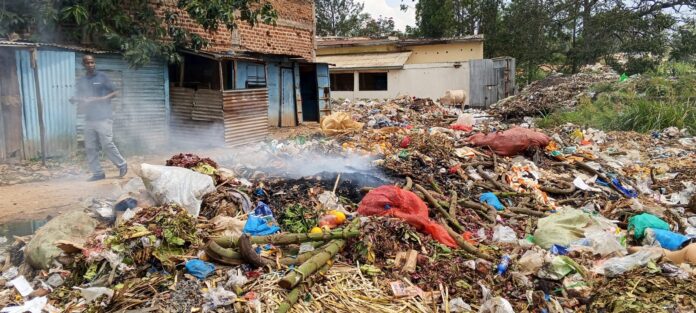
MIGORI: The filth in Migori town, county’s Central Business District (CBD) is beyond superlative comparison, pungent stench of decaying trash hits long before the overflowing mounds come into view.
At the CBD, vast heaps of decomposing organic refuse, single-use plastics, and discarded debris choke drainage channels and spill onto roadsides, sparking urgent fears over public health and environmental decay.
The refuse accumulates alarmingly close to roadside food stalls, where swarms of flies buzz over rotting leftovers and stray livestock forage through open dumps.
For local residents and climate activists, the eyesore points to systemic breakdowns in municipal waste services that directly jeopardize the town’s freshwater sources, local livelihoods, and public health.
Charles Osewe, the chairman of Bunge La Wananchi Movement Migori county, points out the injustice facing taxpayers who see little return in municipal upkeep.
He notes that while local traders pay daily levies, they are forced to sell food directly alongside heaps of foul waste.
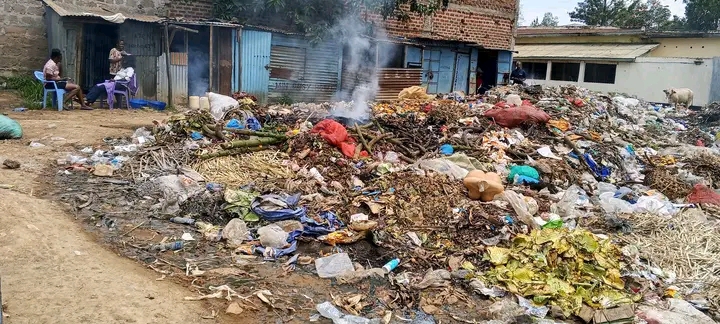
Osewe warns that when heavy rains strike, toxic runoff and loose trash wash into the Migori River, threatening downstream families and farmers who rely on the river for their primary water supply.
“Migori county government collects taxes every single day from these traders, yet people are forced to sell food right on top of rotting trash,” says Charles Osewe adding that, “When it rains, the runoff washes this filth straight into the Migori River,the very water our households use for drinking and farming.”
Osewe highlights a grim paradox of municipal governance across the Global South.
“Despite paying daily levies and supporting a dedicated bureaucracy complete with environmental directors, chief officers, ministers, and NEMA officials,the community sees zero operational intervention on the ground.”
Health hazards
Local civic leaders emphasize that the uncollected waste is a growing health emergency demanding rapid intervention.
Rashid Ouma, chairman of Bunga la wananchi Suna West, questions why residents pay taxes morning and evening while bad odors fill the air and disease vectors multiply.
He warns that failing waste infrastructure, coupled with overcrowded local clinics, leaves vulnerable populations exposed to waterborne illnesses and sanitation-related infections, particularly during extreme weather and flash flooding.
“Tell us if the task is too much for you to handle, the public can take it up,” Rashid Ouma points out.
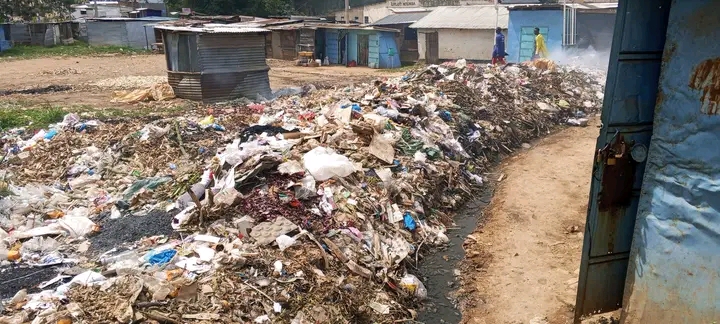
“We pay taxes yet the surrounding is filthy, stench fill the air, and diseases causing micro organisms are breeding everywhere.”
“Today, doctors and nurses are on strike,” Ouma warns.
“Meanwhile, dirty runoff carrying micro-trash flows directly from the flooded markets into the Migori River. That is the same water the public drinks. We are looking at a catastrophe in the form of typhoid, bilharzia, and cholera. At the same time our health centers are overflowing and unable to help. This trash is killing our daughters, killing our women, and destroying our livelihoods.”
Threats to ecosystem, water sources, and tree cover
The environmental damage reaches far beyond Migori’s streets. Leonard Okumu, a local environmental activist, explains that unmanaged waste degrades soil, poisons waterways, and disrupts aquatic life when stormwater sweeps plastics and chemicals into rivers.
“The systemic ecological decay in Migori begins at the ground level within terrestrial and soil micro-ecosystems”.
Toxic chemicals leaching from decomposing plastics and rotting refuse soak directly into the earth, suffocating essential subterranean organisms and stripping the land of its natural fertility.
At the same time, these unmanaged dumpsites attract aggressive pests and dangerous scavengers into residential neighborhoods, driving up vector-borne diseases and creating an immediate crisis for public health.
This environmental degradation rapidly escalates into a full-scale aquatic ecosystem collapse during heavy downpours.
Stormwater washes chemical-laden runoff and microplastics straight into local river basins and onward to Lake Victoria.
He further explains that once these pollutants are in the water, they coat the surface, choke aquatic life, and trigger severe hypoxia by plummeting oxygen levels.
The resulting fish die-offs directly threaten local biodiversity and undermine the primary source of food and income for surrounding fishing communities.
“When toxic chemicals and plastics enter our waterways, they suffocate aquatic life and decimate fish populations, directly impacting the food we eat,” Okumu cautions.
“On land, heavily polluted waste piles attract dangerous, disease-bearing vectors into human living spaces while destroying the soil. We are actively poisoning both our land and our water.”
Compounding these threats is Migori’s severe reforestation and canopy deficit.
The county currently lingers at a dangerously low 2 percent forest cover,a stark contrast to regions like Nyeri, which boast around 30%.
Without adequate tree cover along riverbanks to anchor the soil, absorb excess moisture, and naturally filter toxic runoff, the region is left defenseless.
Heavy rains bring disaster
As a result, heavy rains trigger violent flooding in areas like Nyatike constituency sweeping waste into water sources, while dry seasons plunge the area into severe droughts, locking the community in a dangerous cycle of environmental instability.
Crucially, Okumu emphasizes that tree planting and restoring natural vegetation are vital lines of defense.
Protecting riverbanks with tree cover helps reduce soil erosion, slows down fast-moving surface runoff, and prevents trash from being easily swept into waterways.
Because Migori currently suffers from limited forest cover, Okumu stresses that strategic reforestation and environmental restoration are urgently needed to cushion the region against increasingly unpredictable weather patterns and heavy rains.
Turning waste into wealth
Despite the severity of the crisis, environmentalists see a major economic opportunity if county authorities pivot toward a circular economy rather than open dumping.
Okumu envisions a system where waste is viewed as a financial resource.
By investing in sorting, recycling facilities, and waste-to-energy systems, the county could turn plastic waste into manufacturing materials and organic waste into useful energy or compost.
“We must realize that waste is wealth,” Okumu argues noting that, “Plastics polluting our roadsides shouldn’t be dumped,they must be recycled into valuable secondary products that generate steady income for local residents.Furthermore, segregated organic waste can fuel local incineration plants to generate electricity, providing free or low-cost power directly to vulnerable families who cannot afford electricity bills.”
He notes that shifting away from the costly practice of simply moving garbage from one corner of town to another would simultaneously create local jobs, clean up the environment, and safeguard public health.
“Currently, counties spend vast sums just dumping garbage from one corner of town to another. That is completely unsustainable,” Okumu adds.
“By establishing waste-to-energy incinerators and recycling industries, we turn a public health hazard into a productive resource that empowers needy residents, creates jobs, and halts environmental pollution.”
A local crisis with global echoes
Migori’s struggles reflect the broader waste and climate challenges confronting fast-growing towns across developing nations, where rapid urbanization outpaces recycling infrastructure and regulatory enforcement.
The upcoming COP31 Climate Summit in Antalya, Turkey, is set to pivot global climate action toward local, actionable solutions, directly elevating initiatives like those seen in Migori to the world stage.
Central to the conference will be the push for direct sub-national adaptation financing, a mechanism designed to bypass bureaucratic delays and channel global climate funds straight to municipalities.
This targeted capital aims to empower local leaders to immediately fund high-impact projects, such as municipal waste-to-energy incineration plants and regional soil restoration initiatives.
Alongside these direct financial frameworks, negotiators will focus on stricter methane pledges and circular power systems, enforcing binding targets to capture landfill gas and convert organic decay into reliable, off-grid energy for underserved rural communities.
In addition to energy and financing reform, COP31 will tackle systemic environmental degradation through binding international governance and ecosystem protection.
World leaders will work toward finalizing global plastics treaty protocols, setting standard circular economy metrics that hold petrochemical producers legally and financially responsible for plastic pollution in developing markets.
Complementing these market regulations, delegates will integrate mandatory river-basin protection and native forest restoration targets into national adaptation plans.
By prioritizing aquatic biodiversity and agricultural soil health alongside energy innovation, the summit aims to deliver a holistic framework that connects global policy directly to grassroots resilience.
Demanding accountability
As heavy El Niño rains threaten to wash tons of garbage into drinking water sources and nearby rivers, residents are demanding immediate structural reform from both county leaders and environmental regulatory bodies.
“If the leadership cannot maintain a clean town today, they are failing the generations of tomorrow,” says Ouma.
“The environment department, National Environment Management Authority (NEMA), and local leadership must step out of their offices and fix this. We need clean streets, safe rivers, and real solutions before it is too late.”
Ultimately, Migori faces a critical crossroads: either transform its waste into an economic driver for a cleaner future, or continue paying the price through polluted waters, ruined soils, degraded forests, and compromised public health.