
MIGORI: A recent visit by the Migori Deputy Governor to Binguitwi Primary and Junior Secondary School in Kuria West has exposed a deeper problem facing public institutions across the county: schools and other public facilities are operating on land whose ownership remains legally unsecured.
The Deputy Governor’s visit to the school in Nyabikaye Location was prompted by concerns over low school attendance, extreme poverty, inadequate classrooms and teachers, and the growing involvement of children in casual labour, particularly sand harvesting.
Behind the immediate challenges facing Binguitwi Primary and Junior School lies a longstanding land-ownership problem.
The school, established in 1997 after parents contributed money to purchase land, still does not have a title deed almost three decades later.
Head teacher Joyce Nyangi says efforts to secure the school’s ownership documents have stalled because the land requires succession, a process the school community says is far too costly for local parents to undertake.
The problem is not unique to Binguitwi, across Migori County, questions over ownership documentation have also affected public institutions, including health facilities, raising concerns over how the government can adequately protect, develop, and plan for facilities whose land ownership has not been conclusively secured.
At Binguitwi, the absence of a title deed has become more than a legal inconvenience.
It has complicated efforts to develop the school and leaves the community without the full security that formal ownership provides.
Nyangi says the parents bought the land when they established the school because children had to travel long distances to access education.
Today, the school has about 696 learners, yet despite its growth, the institution continues to operate without a title deed and without a perimeter fence.
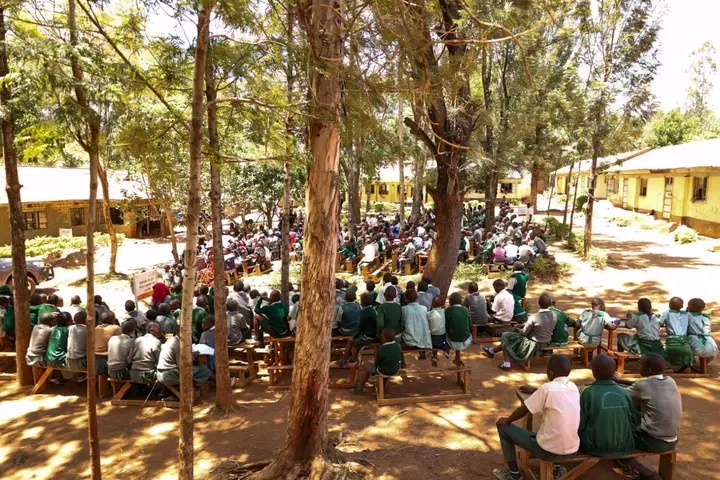
The head teacher says the school has also struggled with inadequate classrooms, particularly at the early childhood development (ECDE) level.
“We have only one classroom for our ECDE,” she said, explaining that the school has had to cope with limited infrastructure despite serving a large population.
The county government constructed a toilet for the ECDE section during the current term and improved some classrooms, including installing tiles, developments the school administration welcomed.
Nyangi says, however, the lack of a title deed remains one of the school’s most urgent unresolved problems.
The absence of a fence presents another challenge. With limited funds and no specific allocation to construct one, pupils can move in and out of the school compound through different points, making supervision and maintaining discipline difficult.
Children leaving class for casual labour
While land ownership threatens the school’s long-term development, poverty is creating a more immediate danger: taking children away from classrooms. School officials say a number of pupils have been forced to stay at home to participate in sand harvesting along rivers.
Nyangi says teachers have visited the homes of affected children and engaged their parents in an effort to persuade them to return to school—an intervention that has yielded some success.
According to the head teacher, about eight children who had dropped out returned to school after teachers engaged their families, but about four others have refused to return and continue working in sand harvesting activities.
The head teacher attributes the situation largely to extreme poverty. Some of the children, she says, are being raised by elderly grandparents who struggle to provide basic necessities such as food. For such families, sending a child to school competes directly with the need to put food on the table.
“It is because of poverty at home,” Nyangi said, explaining that some elderly guardians have resorted to involving children in sand harvesting so that they can earn money for food.
The chairman of the school’s Board of Management, Mark Gath, says the community has already reported the problem to the local administration. He says the intervention of the area sub-chief has helped some children return to school, although the problem remains under monitoring.
The situation illustrates a difficult reality in parts of rural Migori: for some families, education is not being abandoned because parents do not value it, but because poverty is forcing them to make choices between immediate survival and a child’s future.
Staff shortage
Binguitwi also faces a shortage of ECDE teachers. Although the school considers its primary and junior school staffing relatively stable, the ECDE section has only one teacher serving children in Playgroup, PP1, and PP2.
Gath says the single teacher is overwhelmed by the number of learners. The school notes that the teacher has already undergone an interview and is awaiting employment by the county government, and the Board of Management is now appealing to the county administration to expedite the process.
The Deputy Governor acknowledged the staffing and infrastructure gaps, saying the county government needs to increase the number of classrooms and provide another teacher, particularly because ECDE falls under the county government’s responsibilities.
The cultural puzzle
School officials say poverty is not the only threat to children’s education.
Cultural practices, particularly female genital mutilation (FGM) and early marriage, remain concerns in parts of Kuria, although the school says it has not recorded pregnancies or early marriages among its recent Grade Nine graduates.
Nyangi says the prevalence of FGM has declined significantly but has not disappeared completely.
Teachers continue to engage learners on the dangers of the practice and encourage girls to protect themselves from harmful cultural practices.
She singled out teacher Celine Nsato for her role in talking to pupils, particularly girls, about their safety and the importance of remaining in school.
The Deputy Governor also warned that the traditional circumcision season expected around November and December could disrupt children’s education.
He urged parents to ensure that children return to school after the holidays instead of being pushed into early marriages, casual labour, or other activities that could permanently interrupt their education.
The Deputy Governor said his visit was part of efforts to understand why some children in the area are not attending school consistently. Binguitwi, he said, serves a community where many families live in difficult economic circumstances.
The area also experiences sand harvesting, particularly during periods when families are searching for alternative sources of income. Children can consequently find themselves caught between the classroom and the need to help their families survive.
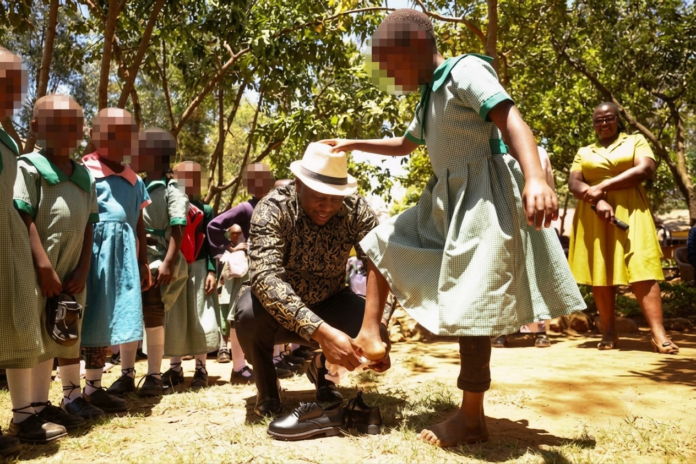
The Deputy Governor said the county government would look into areas within its mandate, including improving ECDE infrastructure and addressing the shortage of teachers. He also distributed shoes to children from nursery through Grade Three—a gesture that, for some pupils, represented much more than a simple gift.
Parents raise power and water concerns
Elizabeth Robi, a parent at Binguitwi and a local resident, said she was grateful for the shoes given to the children but urged authorities to address other challenges affecting the school.
She cited unreliable electricity and the use of a water source inside the school compound. According to Robi, parents sometimes enter the school to collect water even when pupils are sitting examinations, creating difficulties for both learners and the school administration.
During major examinations, she said, parents may have to wait until the examination sessions are over or travel long distances to find alternative water sources.